



The length of this piece provides the respect this story deserves. But not everyone has time to digest it fully. That’s why in this article, the Unbreakable Ventures team has created the Karex Intelligence Map.
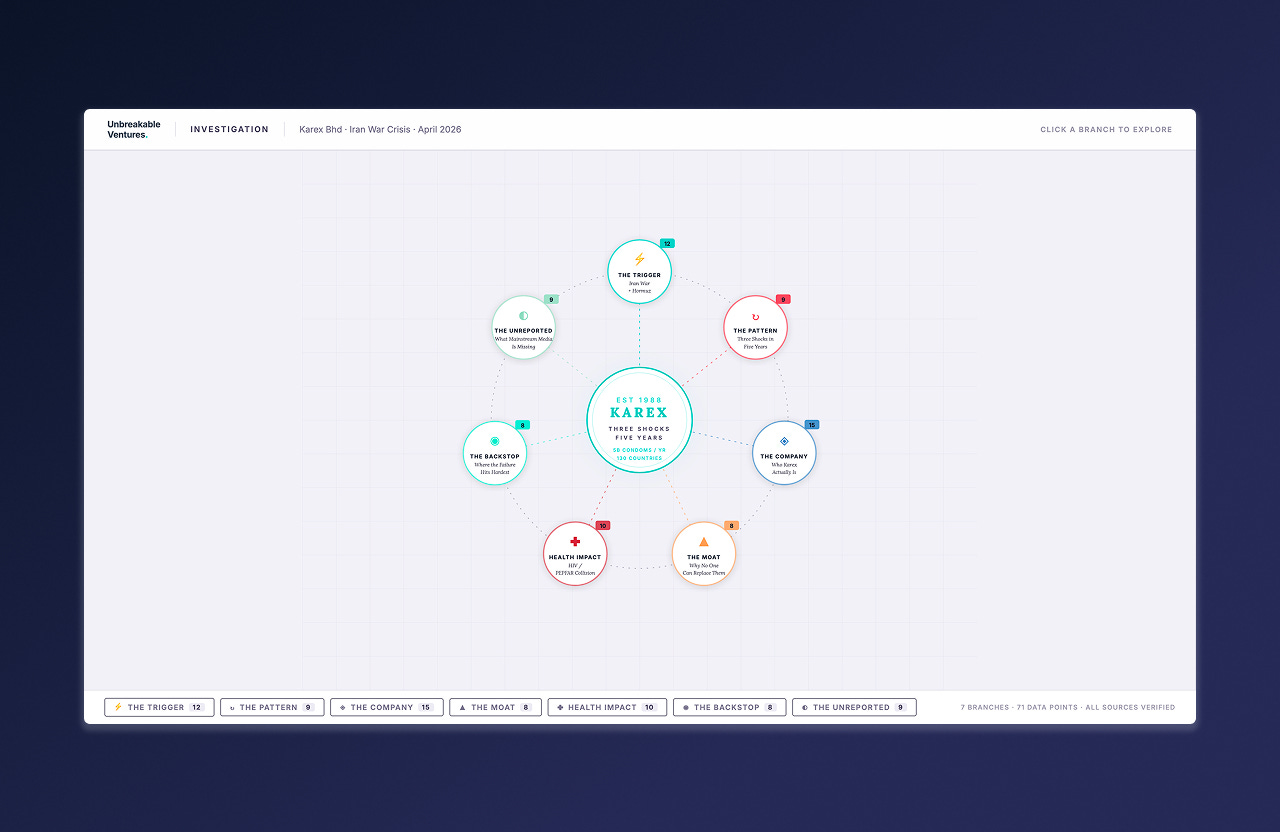
The map has seven branches: The Trigger, The Pattern, The Company, The Moat, The Health Impact, The Backstop, and The Unreported. Each one breaks down into smaller sections you can click through. The article and the map cover the same ground in different shapes. The article tells you the story; the map shows you the connections.
If you only have five minutes, click through the map. If you have twenty, read the article. If you have thirty, do both.
There is a factory in Port Klang, Malaysia, you have probably never heard of. It makes one out of every five condoms worldwide. And on April 21st, 2026, three sentences from its CEO to a Reuters reporter rippled through pharmacies from Auckland to Dubai, Lagos, and Kuala Lumpur.
The company is Karex Berhad. The CEO is Goh Miah Kiat, known to everyone in his industry as MK. The story he just told the world about a war four thousand kilometres away is, if you read it carefully, also a story about why the modern global economy keeps breaking in the same place.
This is not Karex’s first crisis. It is their third in five years.
In 2020, the COVID-19 pandemic shut down their factories. Sales fell 40 per cent over two years. In 2020, the company posted its first full-year loss since going public on Bursa Malaysia, the countries stock exchange. MK had bet, publicly; that lockdown would drive demand up. Instead, it cratered.
In 2022, Russia invaded Ukraine. Russia happens to be a major producer of ammonia, which preserves latex, and of synthetic rubber precursors. Karex’s FY2022 annual report named the war directly, citing inflationary pressures and supply chain disruption. The company set a record for revenue and a record for losses in the same financial year.
In February 2026, Iran went to war with the United States and closed The Strait of Hormuz. By April, Karex was telling Reuters it would raise prices 20 to 30 per cent, perhaps more. MK said current shipments were taking “close to two months.”
Three different geopolitical events. Three direct hits on one factory. There is no structural reform between any of them. But there is a fundamental lesson in dealing with concurrent crises.
Why a 33km of ocean sets the price of latex
To understand how a tanker dispute in the Persian Gulf reaches a Wellington pharmacy, we should follow the chemistry.
Latex condoms need Russia’s ammonia. Non-latex condoms use nitrile, which is made from butadiene, which is made from naphtha. Roughly 60 to 70 per cent of Asia’s naphtha transits the Strait of Hormuz, arriving from Gulf countries. Lubricants are silicone-based, and also petrochemical. The foil that wraps each condom individually is aluminum, much of it produced in the UAE using cheap Gulf energy.
The result is Karex’s price list moves whenever something breaks in the Gulf or Eastern Europe. According to figures cited to CNN by Davin Wedel, who runs Karex’s US subsidiary Global Protection Corp, synthetic rubber is up 30 per cent, nitrile up 100 per cent, silicone oil up 25 per cent, and packaging foil up 20 to 30 per cent. Wedel told CNN the situation was “adding fuel to the fire” given existing US tariffs.
For those in the Gulf, this is an awkward truth: your region produces the chemistry that makes most of the world’s condoms possible. For ASEAN, Malaysia is the manufacturing hub the rest of the world does not notice until it stops working. For New Zealand, the price you will pay at the pharmacy in three to six months is being set right now on a vessel that may or may not arrive.
Karex’s largely unreported influence
The chairwoman of Karex’s board is Professor Dato’ Dr. Adeeba Kamarulzaman. She is the President of Monash University Malaysia. She is also a former President of the International AIDS Society, the chairperson of the Malaysian AIDS Foundation, a member of the WHO Science Council, and a member of the UNAIDS Advisory Group.
She chairs the board of the company at the centre of the global condom supply crisis. She also advises the international institutions most affected by Karex’s pricing decisions on HIV prevention commodities.
Both roles are fully public. Neither is a secret. They have simply not been connected by any outlet covering the price hike.
It matters because the HIV picture is already grim before condoms get more expensive. A March 2025 modelling study published in The Lancet HIV projected that an anticipated 24 per cent average reduction in international aid combined with discontinued PEPFAR support could mean between 4.43 million and 10.75 million additional new HIV infections, and between 770,000 and 2.93 million extra deaths, between 2025 and 2030 across low- and middle-income countries. The researchers noted infection rates would be 30 to 60 per cent higher in key populations such as sex workers, men who have sex with men, and people who inject drugs.
Stockpiles were already thin. UNAIDS reported in May 2025 that around a quarter of countries surveyed held six months or less of condom stock. That is the buffer Karex’s price hike now lands on top of.
The usual contingency, scaling up PrEP (pre-exposure prophylaxis) to substitute for condom-based prevention, is also wobbling. The same PEPFAR pause that emptied condom programmes also disrupted PrEP delivery in sub-Saharan Africa.
A separate Lancet HIV modelling study published in October 2025 estimated that a one-year pause of PEPFAR-funded PrEP could result in 15,739 new HIV infections over five years. You cannot replace one disrupted prevention tool with another disrupted prevention tool.
This is the room the Karex chairwoman walks into when she joins a UNAIDS Advisory Group meeting.
The product no one is writing about
As with most crisis events, there are connections that influence the other.
Karex owns Satin Oral Dams through its US subsidiary, Global Protection Corp. Dental dams are made from the same latex and nitrile facing the same supply disruption. They are used during oral sex for STI and HIV prevention, particularly among LGBTQ communities and women.
The price hike hits dental dams. Nitrile is up 100 per cent, harder than any other input. The institutions that distribute them, NHS sexual health clinics in the UK, Planned Parenthood in the US, AIDS Healthcare Foundation, Brook, GMHC, are operating on fixed budgets.
This matters because the silence is selective. The same supply chain hits both products. The same regulatory wall blocks emergency substitution for both. The difference is that one gets a global news cycle and the other gets nothing. When you watch how a crisis is told, watch what it leaves out. The populations most affected here are not the ones being asked to comment on it.
The certification moat
One could argue that Karex is integral to our health system but comes with many vulnerabilities. So, why does no one else make condoms?
Because like semi-conductors, they do not have the infrastructure to simply replicate the process. And building one is not a quick process.
Institutional buyers require the World Health Organization (WHO) prequalification of manufacturing sites. The process takes one to three years.
Across multiple sites, Karex’s deep, multi-regulator quality and market-access certifications form a barrier that is difficult for competitors to replicate quickly.
Alternatives exist like India’s HLL Lifecare, government owned and prequalified, but capacity is small. China has Guilin Latex, which has scale but also geopolitical baggage and certification gaps. Cupid Limited in India is the only company prequalified for both male and female condoms, but its male output is modest. SKYN’s polyisoprene is less Hormuz dependent, but it is a retail premium product, not an institutional bulk supply.
In an emergency, you cannot swap suppliers. The bottleneck is not rubber. The bottleneck is regulation.
A pyramid of problems
The world’s two largest condom brands are structurally dependent on outsourced manufacturing, with limited in-house production relative to their global output.
Durex, is owned by Reckitt Benckiser of Slough, UK. Trojan, is owned by Church & Dwight of Ewing, New Jersey. The exact percentage of dependency is not publicly disclosed by either side. But it’s clear there is an awkward triangle.
Karex makes Durex while competing with Durex through its own ONE, Pasante, and Carex brands. Karex makes Trojan while competing with Trojan through ONE again. The price hike pushes margin pressure onto Reckitt and Church & Dwight at exactly the moment those companies have their strongest incentive in years to find someone else to make their products.
Reckitt launched Durex Intensity, a nitrile condom, in late 2024 with a global Q1 2025 rollout. Nitrile then doubled in price. Church & Dwight launched TROJAN G.O.A.T. in January 2026 using a patent-pending Ultra Flex non-latex material. The actual chemical composition is not in public filings. Whether it really decouples from the Hormuz supply chain is anyone’s guess.
This interconnected web of suppliers is a fragile balance easily disrupted by the other. But it’s not unique to condom manufacturing. Thousands of businesses around the world are impacted by the ripple effect the Strait’s closure represents, if nothing more than through a break in a third party’s link.
When the backstop is uneven
If a condom fails or a couple cannot afford one, what comes next depends entirely on where you live. This is where the Karex story stops being only about supply chains and starts being about geography.
ASEAN. Across Karex’s home region, the legal backstop varies wildly. Malaysia’s own Penal Code Section 312 has, since a 1989 amendment, permitted abortion to preserve a woman’s life or her physical or mental health, putting Malaysia among the more permissive countries on paper.
In practice, mifepristone is not registered in Malaysia, public hospitals often require two doctors instead of the legally mandated one, and stigma keeps many providers silent. As recently as May 2025, a 21-year-old woman in Melaka received a nine-month custodial sentence for a self-managed abortion using pills bought online. The Galen Centre noted in the same piece that one in three Malaysian pregnancies in 2022 was unplanned.
The Philippines maintains a near-total criminal ban with no health exceptions. Indonesia restricts abortion to medical emergency and rape. Thailand decriminalised abortion through 12 weeks in 2022. Singapore is liberal.
The result: a single ASEAN-wide condom price hike lands on legal systems that range from progressive to punitive, and the women paying the highest cost are those in jurisdictions with the fewest legal options afterwards.
Oceania. New Zealand decriminalised abortion in 2020 and treats it as a health matter through 20 weeks.
Australia varies by state but is broadly accessible. The legal backstop is real. The pressure is therefore financial rather than legal. When retail prices rise, public health budgets like Pharmac and DHB-funded sexual health clinics absorb the difference. The system holds, but it costs more, and the cost falls on taxpayers and clinic budgets rather than on women’s legal rights.
GCC. This is where the dynamic flips most sharply. Across Saudi Arabia, the UAE, Kuwait, Qatar, Bahrain, and Oman, abortion is generally permitted only to save a woman’s life or in cases of severe foetal impairment, and access is medicalised, gatekept, and culturally constrained.
In several Gulf states, sex outside marriage remains a criminal offence. For migrant workers in the region, particularly the women working as domestic staff with confiscated passports, an unwanted pregnancy is not just a health event but a legal and immigration crisis.
The condom is functionally the only contraceptive backstop available before a pregnancy becomes a problem the legal system will not help solve. A 30 per cent price increase on that backstop has a sharper edge in the Gulf than almost anywhere else.
A modelling study by Avenir Health for the Lancet projected that USAID contraceptive cuts alone could mean 40 to 55 million extra unintended pregnancies and 12 to 16 million unsafe abortions across affected countries. That was before the Karex price hike. The Karex hike sits on top of this.
The lesson in this crisis
For New Zealand, this is a Pharmac story before it is a Woolworths story. As Olsen put it to Stuff, retailers and public buyers will be deciding whose budget swallows the increase.
Public health budgets, not retail margins, will absorb most of the impact, and that decision is being made now in offices that do not usually think about Hormuz.
For ASEAN, this is a story about your region’s manufacturing exposure. One factory cluster, three regional supply shocks in five years, no structural reform between them. Myanmar and Cambodia are already rationing fuel. Vietnamese schools have shortened hours. The next shock is not a question of if, but when.
For the Gulf, this is a mirror. The materials that make most of the world’s condoms come from your refineries, your industrial complexes, and your ports. The fragility being exposed in Port Klang is a fragility your region helped create, and one your region can help solve.
But this story is not really about condoms. It is about what happens when a single factory becomes structurally important to global health, when its supply chain runs through three of the world’s most volatile regions at once, and when no one wants to spend the money to build redundancy until the moment redundancy becomes impossible.
We need institutional reform. We need government support and investment in supply chain disruption. We need to get involved early when a significant supplier shows signs of becoming a single point of failure to critical infrastructure or public health.
Karex has been telling us this story for five years. But we’re often distracted by the topic, rather than the lesson it serves.
