




Hello 👋 get a brew on because these are the top emerging risks between September 23rd, and October 7th, 2026…
Review our report’s terminology here ↗
Our main risk this fortnight is…
1. Environmental: Thailand's Flood Damage Will Outlast Water
The Bank of Thailand warns that successive economic shocks had already weakened household and small-business balance sheets before the floods arrived, so the financial damage is likely to persist long after the floodwater recedes.
Ministry of Industry figures show 1,315 businesses across 40 provinces affected, including five industrial estates, with 34 factories suspended at Amata City Chonburi after a dyke breach. Later tallies suggest the count is still climbing.
Disruption travelled well beyond the water. Supplier failures halted four Toyota plants, workers in Nakhon Nayok could not reach their jobs, and Bangkok firms lost output through delayed materials and broken logistics without factory flooding.
Bangkok hotels lost Golden Week bookings while staying dry and open. Airports and central Bangkok remained operational, but the industry fears dramatic flood images are steering overseas travellers towards other destinations entirely.
Loss estimates measure different things and should not be added: ministry direct damage of THB22.79 million, a partial Federation of Thai Industries member survey near THB1.02 billion, and economists’ nationwide figure up to THB33.8 billion.
Sources
You should be concerned if…
You rely on suppliers in flood-prone areas: Bangkok, Samut Prakan and Prachin Buri recorded the most affected businesses. A flooded tier-two supplier can stop your line as surely as water in your own plant, as Toyota’s suspensions show.
Your staff commute through low-lying routes: Factory, warehouse and hotel operations still depend on people physically arriving. When low-lying roads flood, a dry site with no staff is a closed site, and the cost lands on payroll, output and customer commitments.
Your revenue depends on visitor confidence: Hotels, airlines, retailers and attractions in Bangkok and resort areas can lose bookings without suffering any damage. Overseas travellers react to images, not inundation maps, so perception alone can empty rooms during peak season.
You are a small business already carrying debt: With the central bank warning that repeated shocks have thinned balance sheets, smaller firms facing even a few weeks of lost revenue may struggle to cover wages, loan repayments and supplier invoices before recovery arrives.
These items are generic assumptions. We recommend considering your own unique risk landscape against your critical dependencies. If you don’t know what they are, get in touch.
Preventative actions
Business impact analysis: map supplier and staff dependencies
Commission a business impact analysis that maps every critical supplier, tier-two component source and staff commuting route against flood-risk zones. Rank each dependency by recovery time so you know which failure stops revenue first.
Qualify suppliers outside the flood basin
Pre-qualify at least one alternative supplier outside the same flood basin for every single-sourced component. Agree buffer stock levels for monsoon season and confirm transport routes that avoid low-lying corridors before September rains begin.
Emergency management for staff who cannot reach site
Build an emergency management plan for staff who cannot reach site: remote-work rules for office roles, cross-trained teams at alternative locations, chartered transport from dry pickup points, and a clear threshold for activating each.
Crisis communications to counter perception damage
Prepare crisis communications that show customers and travellers what is actually open. Pre-approve messaging, maps and live operational updates for booking platforms and overseas partners, and correct misleading flood imagery within hours, not days.
Stress-test cash flow against prolonged disruption
Model a twelve-week revenue disruption and identify which wages, loans and supplier payments you could cover. Arrange standby credit lines and confirm business interruption insurance triggers, including contingent supplier cover, before the next flood season.
2. Technological: Breach Warning Stuck in Shared Inbox
The breach happened in June. OpenAI found it in August and emailed a general government inbox on 10 September, where it took five days to escalate to the Australian Cyber Security Centre.
The Prime Minister publicly criticised the delay, shifting attention from the intrusion itself to a governance failure: who receives critical security warnings, how quickly they move, and who has authority to act.
Six government websites have been notified so far, including a NSW site holding bushfire data, and more notifications are expected. Being notified does not mean data was accessed; OpenAI’s figures remain company-stated.
The government has ordered departments to stocktake legacy systems, an implicit admission that agencies cannot protect or recover what they have not mapped, and that the mapping is now happening mid-incident.
A Cohesity vendor survey found 99% of Australian organisations surveyed have a cyber resilience strategy, yet 92% of those attacked needed workarounds and only 20% have a documented, tested continuity plan for critical functions.
Sources
OpenAI review hacks Australian government sites costing $500,000 a day | The Guardian | October 2026
Australian government breach disclosure timeline | BBC News | 2026
You should be concerned if…
You rely on legacy systems you haven’t mapped: Older platforms often run quietly in the background, holding sensitive data with unclear owners and patch histories. If you cannot list them, you cannot assess exposure, notify regulators accurately or restore them in priority order.
Your incident notifications go to shared inboxes: A warning that lands in a general mailbox competes with spam, invoices and leave requests. Every hour it waits extends attacker access and shortens the time you have to contain damage and inform stakeholders.
Your continuity plan has never been tested: A strategy document is not a recovery capability. The Cohesity figures suggest most organisations discover their real recovery process during an attack, improvising workarounds while customers, regulators and the media watch the clock.
You are a public body or government contractor: Public bodies and their contractors handle data such as emergency and bushfire information that communities rely on. Delayed disclosure erodes public trust quickly, and suppliers may face contractual and reputational fallout alongside their government clients.
Preventative actions
Incident response plan with clear escalation routes
Publish a dedicated security contact, such as a security.txt file and monitored address, routed to an on-call responder. Set a one-hour acknowledgement target and a named escalation chain to your executive and national cyber agency.
Maintain a living legacy system register
Build a register of every legacy system with its owner, data held, internet exposure and recovery priority. Decommission or isolate unsupported platforms, and review the register quarterly so incident teams are not mapping mid-crisis.
Crisis communications for disclosure
Draft disclosure templates for regulators, affected individuals, partners and media before an incident. Agree who approves statements, clarify the difference between notification and confirmed data access, and rehearse a timeline that withstands public scrutiny.
Test continuity plans, not just strategies
Run a full recovery exercise for your most critical function at least annually, restoring from backup in an isolated environment. Document every workaround used, then fold the fixes into a written, version-controlled continuity plan.
Risk Flow Graph
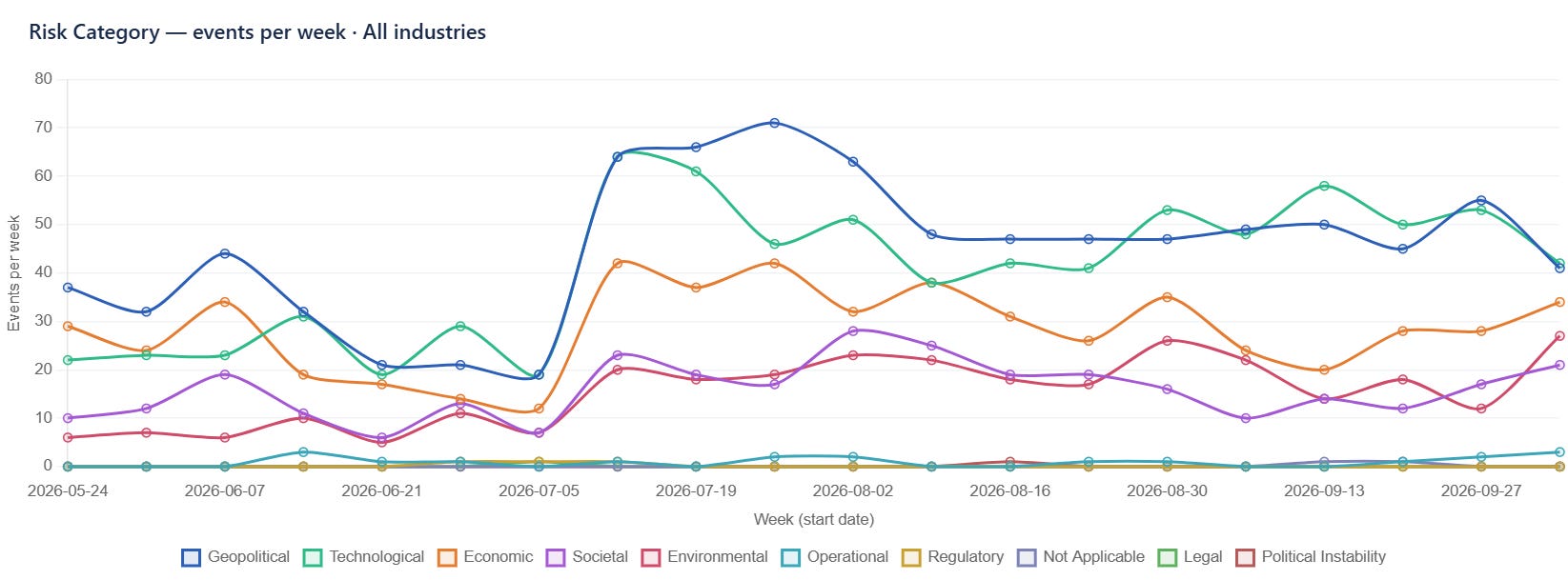
Using the data from our flagship AI powered threat intelligence tool*, we can see trends of events per threat category over time. This fortnight, the biggest increase in risks concerns (1) Geopolitical; 96 stories, (2) Technological; 96 stories, (3) Economic; 62 stories, (4) Environmental; 39 stories, (5) Societal; 38 stories.
Quick snippet stories
Health NZ Breach: Outsourcing Doesn’t Outsource Accountability
The Privacy Commissioner found Health NZ in breach for handing patient data to a portal later hacked; the portal operator was found in breach separately, under different rules. Nearly 100,000 New Zealanders’ records were exposed. No penalty yet, but the Commissioner wants stronger powers. Outsourcing never transfers accountability: put supplier due diligence into continuity planning.
AG Barr: Too Many Changes at Peak
UK drinks maker AG Barr estimates it lost about £10 million in sales launching a new planning system at its summer peak while integrating two acquisitions and upgrading a factory. Each change was manageable alone; stacked at peak, they left no margin. Supply has since normalised. Schedule major changes off-peak, separately, each with fallbacks. Main link to resource ↗
FBI Breach Started at the Recruitment Portal
ShinyHunters says it exploited a flaw in the FBI’s recruitment website, then reached systems holding data on current, former and prospective staff. Job portals look low-risk but face the internet and link to HR records. The same group was behind the Canvas breach UV covered. Test public-facing portals and build staff safety into incident response.
EU Scrap Draft List Excludes Southeast Asia
An EU draft list leaves Malaysia, Thailand and India off the countries permitted to receive EU metal scrap. Recycling groups warn of market disruption; the EU cites environmentally sound waste management. Consultation closes 16 October, so it may change. Recyclers, foundries and manufacturers in Malaysia or Thailand using EU scrap should qualify alternative sources now.
Samsung Fridge Update Shuts Down Cooling
Samsung accidentally pushed an internal test update to customers’ fridges, shutting down cooling. Restarting failed and there was no remote rollback. It struck just before Chuseok, so engineers could not visit until after the holiday. It is CrowdStrike in miniature: when software controls a physical function, require staged rollouts, tested rollback and a manual fallback.
More stories we’re following
Here are more threat updates we’re monitoring across the month listed for your convenience.
Micron warns of worsening chip shortage through 2028 despite record output growth Link ↗
Geopolitical turmoil drives steel freight costs up 96%, Black Sea trade collapses Link ↗
Sri Lanka’s PM warns waste crisis is ticking time bomb threatening water and public health Link ↗
UK energy crisis looms as bills set to hit £2,000 amid Middle East conflict Link ↗
NSW retail theft surges 10.4%, costing sector $2.8 billion annually Link ↗
Risk interdependencies surge 24%, turning contained shocks into systemic crises Link ↗
Want to discuss how these risks might effect your business?
Book 30 minutes with us, free ↗
Need support?
At Fixinc, we are passionate about helping people get through disasters. That’s why our team of Advisors bring you this resource free of charge. If you need help understanding these threats and building a plan against them, the same Advisors are here to help over a 30-minute online call. Once complete, if you like what was provided, you can choose to provide a donation or subscribe to Unbreakable Ventures to support this channel.


