





Hello 👋 get a brew on because these are the top emerging risks between September 10th and 23rd, 2026…
Review our report’s terminology here ↗
Our main risk this fortnight is…
1. Geopolitical: Gulf Shipping Costs Squeeze UAE Trade
War risk pricing has re-rated the Gulf. Insurers are charging around 3 to 10 percent of a vessel’s value for Gulf voyages, up from about 0.25 percent before hostilities began.
Tanker owners face the sharpest repricing. A $100 million tanker now attracts war risk premiums of roughly $3 million to $10 million per voyage, against about $250,000 before hostilities began.
The Strait of Hormuz has shifted from open transit to a controlled, permission-based corridor. Commercial traffic remains far below baseline, concentrated among high-risk or specifically authorised vessels rather than normal liner services.
Human exposure sits behind the freight numbers. Iran’s resumption of tanker attacks included strikes on two UAE supertankers that killed a sailor, with around 6,000 seafarers caught in the region.
Cost pressure has spread beyond cargo into travel and services, with Emirates and Etihad offering to cover passenger travel insurance costs of up to $25,000 to keep demand moving.
Sources
Gulf Trade and Shipping Costs: UAE Impact | Traders Union | September 2026
The Gulf is paying the price of risk | AGBI | September 2026
One Month of War in the Gulf: Mapping the Global Maritime Disruption | Windward | September 2026
Gulf war risk premiums topping double-digit millions of dollars per trip | Lloyd’s List | March 2026
The Strait of Hormuz crisis explained: What it means for global shipping | CNBC | March 2026
You should be concerned if…
Importers and distributors routing through Jebel Ali or Gulf ports: Landed cost models built on pre-conflict freight and insurance assumptions no longer hold. Surcharges and premium loadings arrive after booking, eroding margin on contracts already priced and signed with customers.
Energy buyers and petrochemical off-takers in Asia and Europe: Hormuz is the only sea route for major Gulf crude, LNG and petrochemical exports. Permission-based transit means supply arrives on someone else’s schedule, not the terms written into your delivery contracts.
Marine underwriters, brokers and captives: Premium levels moving from about 0.25 percent of hull value to as much as 10 percent, with Israel-bound calls tripling, signal a market repricing faster than most reinsurance programmes were structured to absorb this treaty year.
Shipowners, crewing agencies and seafarer employers: With roughly 6,000 seafarers caught in the region and a fatality already recorded on a UAE supertanker, duty-of-care obligations, crew retention and manning costs all escalate simultaneously.
Manufacturers with Gulf-dependent inputs and long lead times: Rerouting adds weeks to transit while sailings thin out. Inventory buffers sized for stable ocean schedules will be consumed before replacement stock clears alternative routings.
These items are generic assumptions. We recommend considering your own unique risk landscape against your critical dependencies. If you don’t know what they are, get in touch.
Preventative actions
Reprice contracts with war risk pass-through clauses
Rewrite customer and supplier agreements to include explicit war risk surcharge, bunker and insurance pass-through mechanisms, with defined trigger thresholds. Fixed-price commitments spanning Gulf lanes should carry index-linked adjustment or shortened validity periods.
Verify cover before booking, not after loading
Confirm with your broker exactly which Gulf transits, ports and flag states your hull, cargo and liability policies still cover at current premium levels. Document breach-of-warranty positions and additional premium triggers for every planned voyage.
Pre-qualify alternative routings and secondary ports
Nominate and commercially test at least one non-Hormuz routing for critical inputs, including Red Sea, Cape of Good Hope and overland options into the GCC. Run a live shipment through each before you need it.
Rebuild inventory policy around longer, less certain transits
Recalculate safety stock using worst-case observed transit times rather than contractual ones, and separate critical-path components for air freight or forward stocking. Review reorder points monthly while transit variability persists.
Put crew and traveller duty-of-care protocols in writing
Establish written protocols covering crew rotation limits in high-risk waters, evacuation routes, hazard compensation and next-of-kin communication. Confirm personal accident and travel cover extends to conflict-zone exposure before staff or vessels are committed.
Stress-test the cash impact of a sustained premium regime
Model twelve months of elevated freight, insurance and detention costs against working capital and covenant headroom. Identify the point at which specific Gulf trade lanes stop being commercially viable, and decide in advance.
2. Technological: Microsoft Patches Nearly 1,000 Flaws
Microsoft has shipped security fixes addressing close to a thousand vulnerabilities across its product estate, a patch volume that far exceeds what most organisations can test, schedule and deploy in a normal cycle.
Volume itself is the operational problem. Patch backlogs form when remediation capacity is fixed and disclosure volume is not, leaving known, publicly documented weaknesses exposed on production systems for weeks.
Attackers work from the same advisories defenders do. Public vulnerability details give adversaries a precise target list the moment updates are released, compressing the window between disclosure and exploitation attempts.
Windows, Office and Azure components sit under most corporate workflows, so a single unpatched estate creates exposure across identity, email, file handling and cloud management simultaneously.
Sources
You should be concerned if…
Organisations running large, mixed Windows estates: Legacy builds, unmanaged endpoints and machines outside the patch management console will not receive these fixes automatically. Every uninventoried device becomes a documented, publicly described entry point.
Regulated sectors with change-control freeze periods: Financial services, healthcare and utilities often batch patching into scheduled windows. A release of this size will not fit a standard monthly window without a documented risk acceptance.
Small and mid-sized firms without dedicated security staff: Prioritisation requires knowing which vulnerabilities touch your actual configuration. Without that capability, teams either patch nothing promptly or patch everything and risk operational breakage.
Managed service providers and their clients: MSPs patch across many tenants with shared tooling. A missed rollout or a faulty update propagates to every customer at once, turning a maintenance task into a multi-client incident.
Operational technology and clinical environments: Systems that cannot be rebooted on demand, including manufacturing lines, medical devices and building controls, accumulate unpatched exposure indefinitely while remaining connected to the corporate network.
Preventative actions
Triage by exploitability and exposure, not by severity score alone
Rank this release against your own asset inventory. Patch internet-facing, identity and email-handling systems first, then anything with known exploitation activity, before working through internally isolated systems on the standard cycle.
Set and enforce a remediation clock
Define maximum days-to-patch by asset criticality, publish it, and report compliance to the board monthly. Without a measured deadline, large releases silently extend backlogs that nobody owns or reviews.
Maintain a ring-based deployment pipeline
Deploy to a representative pilot group, then a broader ring, then production, with defined soak periods and rollback criteria at each stage. This catches update-induced breakage before it reaches business-critical systems.
Close the asset inventory gap first
Reconcile your patch management console against network discovery, identity logs and procurement records. Devices absent from the console are unpatched by default, and no remediation metric is credible until that gap is quantified.
Apply compensating controls where patching is blocked
For systems that cannot be updated, enforce network segmentation, application allowlisting, credential isolation and enhanced logging. Record each exception with an owner, an expiry date and a scheduled review.
Rehearse the post-exploitation scenario
Run a tabletop assuming one unpatched host was compromised before the update landed. Test detection, credential rotation, lateral movement containment and restoration from offline backups against a defined recovery time objective.
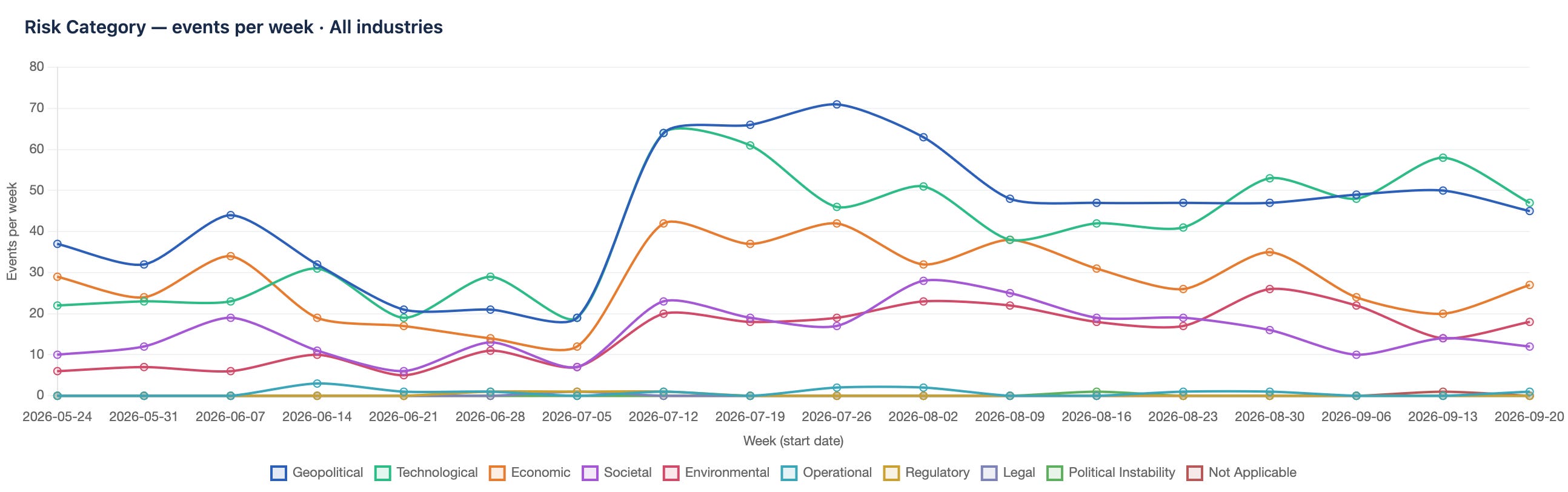
Risk Flow Graph
Using the data from our flagship AI powered threat intelligence tool*, we can see trends of events per threat category over time. This fortnight, the biggest increase in risks concerns (1) Technological; 108 stories, (2) Geopolitical; 97 stories, (3) Economic; 47 stories, (4) Environmental; 32 stories, (5) Societal; 26 stories.
Quick snippet stories
Italy’s Plastic Waste Collection Crisis
Italian businesses face the prospect of plastic packaging waste going uncollected as the collection system comes under strain. Commercial premises without guaranteed uplift risk storage breaches, hygiene issues and regulatory exposure. Contract a licensed private waste operator as a standby, and confirm on-site storage capacity and compliance limits now.
Main link to resource ↗When The River Runs Dry
Drought has become a live supply chain variable, with falling river levels restricting barge loading and inland waterway freight capacity. Bulk commodities, fuels and chemicals are most exposed, since rail and road substitution is costly and slow. Map your inland waterway dependencies and pre-negotiate rail capacity for low-water periods.
Main link to resource ↗South Africa’s Hidden Infrastructure Risk
Deteriorating roads, water systems, ports and electricity supply are quietly eroding South African business operations, often falling outside conventional insurance triggers because no insured damage occurs. Audit your sites for utility and access dependencies, install independent water and power capacity, and confirm whether policies respond to non-damage interruption.
Main link to resource ↗Meat Sector Strains Business Interruption Cover
The meat and poultry sector is testing the boundaries of traditional business interruption policies, where losses stem from disease, supply failure or regulatory closure rather than physical damage. Review policy wordings for non-damage triggers, contingent supplier cover and disease exclusions, and quantify the uninsured gap before renewal.
Main link to resource ↗China’s Factories Need Fewer Workers
Automation across Chinese manufacturing is reducing labour demand even as output holds, fuelling a domestic employment squeeze with social and political consequences. Buyers relying on Chinese production should monitor supplier workforce stability and policy responses, diversify sourcing across at least two countries, and audit labour conditions within tier-two suppliers.
Main link to resource ↗
More stories we’re following
Here are more threat updates we’re monitoring across the month listed for your convenience.
Geopolitical conflict, drought, energy costs drive 11.8% global food price surge in 2026 Link ↗
UK food inflation set to surge to 6.6% in 2027 as El Niño and geopolitical disruption strain supply Link ↗
European manufacturers boost confidence by investing heavily to absorb persistent supply chain shocks Link ↗
Supply chain resilience investments fail to boost performance without integrated operating model Link ↗
Route diversification fails without mapped supply chain chokepoints Link ↗
Japanese firms warn Asean of permanent disruption from geopolitical tensions Link ↗
German auto industry faces historic disruption from Chinese competition and margin collapse Link ↗
Data center sector neglects compound-shock testing despite 91% experiencing major disruptions Link ↗
Anthropic discloses fourth AI model hack incident, exposing persistent autonomous agent risks Link ↗
OpenAI halts Pro plan sales as Astra demand overwhelming infrastructure capacity Link ↗
Fiji declares HIV outbreak national crisis as diagnoses surge 27 percent year-on-year Link ↗
Regulatory mandate elevates business review to real-time risk management as quantum breach exposes governance gaps Link ↗
Extreme heat disrupts supply chains before temperatures peak through workforce, demand, and infrastructure cascades Link ↗
Flooring failures disrupt 63% of Malaysian businesses, with recurring problems costing millions Link ↗
Want to discuss how these risks might effect your business?
Book 30 minutes with us, free ↗
Need support?
At Fixinc, we are passionate about helping people get through disasters. That’s why our team of Advisors bring you this resource free of charge. If you need help understanding these threats and building a plan against them, the same Advisors are here to help over a 30-minute online call. Once complete, if you like what was provided, you can choose to provide a donation or subscribe to Unbreakable Ventures to support this channel.


