



Hello 👋 get a brew on because these are the top emerging risks between July 29, and August 12, 2026…
Review our report’s terminology here ↗
Our main risk this fortnight is…
1. Technological: AI Detectors Are Misfiring On Humans
YouTube’s automated systems for suppressing synthetic content wrongly flagged science channel Kurzgesagt. The system mistakenly targeted the channel, leaving it with its worst-performing upload since 2013.
Nearly every major metric was above average: more viewers clicked, watched longer, and responded positively, yet YouTube seemingly stopped recommending the video. Staff later confirmed detection tools wrongly judged human-made videos as AI slop.
Scale beats fairness in appeals. One creator noted a channel that big can find out and correct this, but not everyone can. The open question is access, and Kurzgesagt had people to call.
LinkedIn runs the same playbook for professional content. Its May 2026 changes suppress flagged posts beyond a user’s immediate network, with detection claiming 94% accuracy though false-positive data has not been disclosed.
Provenance marking is arriving fast. Anthropic is weaving an imperceptible, machine-readable signal into Claude-generated text for models released on or after August 2, and the watermark travels when text is copied and pasted.
Sources
Anthropic says it will watermark text generated by its AI models | TechCrunch | August 2026
LinkedIn Is Suppressing AI Slop: What That Means for You | Neil Patel | August 2026
How Claude marks AI-generated content | Anthropic Help Center | August 2026
You should be concerned if…
Marketing and content teams leaning heavily on generative tools: Partial AI use is the danger zone. Generated text will carry embedded watermarks, and generated files will include digitally signed provenance metadata where supported, meaning lightly edited drafts may still register as machine-made.
Creators and publishers dependent on algorithmic distribution: Penalties are silent, not formal. Flagged content is not labelled but it is throttled, so revenue can collapse before anyone in your organisation identifies the cause or finds an appeal route.
B2B firms building pipeline on LinkedIn: Pangram found roughly 41% of long-form posts and 30% of short-form posts on LinkedIn were likely fully AI-generated. Aggressive filtering of that volume will inevitably capture legitimate corporate communications alongside genuine spam.
EU-exposed businesses and compliance functions: The EU AI Act’s Transparency Code, effective August 2, requires AI companies to mark AI-generated or edited content in a way other systems can identify. Disclosure obligations now flow downstream to anyone publishing that output commercially.
Education, legal, and HR teams using AI text evidentially: Anthropic cautions against treating signals as definitive proof of authorship. Claude may translate or edit human work yet still mark it, while unmarked content does not necessarily mean a human wrote it.
These items are generic assumptions. We recommend considering your own unique risk landscape against your critical dependencies. If you don’t know what they are, get in touch.
Preventative actions
Log human authorship evidence for every published asset
Retain dated drafts, storyboards, raw footage, project files, and named contributor records for all content. Build a retrievable authorship dossier you can submit within 48 hours when a platform suppresses reach without explanation.
Establish a named escalation route with each platform
Do not rely on generic appeal forms. Secure partner managers, verified accounts, or agency contacts at YouTube, LinkedIn, and other distribution channels before you need them, and test the escalation path annually with a live query.
Instrument reach monitoring with automated anomaly alerts
Track impressions, click-through, and recommendation traffic per channel with thresholds that trigger alerts on unexplained drops. Silent throttling only shows up in trend data, so set detection windows measured in days, not quarterly reporting cycles.
Classify AI involvement per asset and disclose accordingly
Tag every piece of content with its generation method: fully human, AI-assisted, AI-generated. Map those tags to EU AI Act Article 50 disclosure duties and platform policies so legal review happens before publication, not after enforcement.
Diversify distribution away from single-algorithm dependency
Build owned channels: email lists, direct subscriptions, RSS, podcast feeds, and partner syndication. Set a target share of audience reached without platform intermediation, and review that ratio quarterly at board or marketing leadership level.
Stress-test your content pipeline against a watermark scenario
Run an exercise assuming detectable provenance marks appear in your published output. Decide in advance which workflows must switch to human drafting, and rewrite supplier and agency contracts to require disclosure of model usage.
2. Economic: Travel Costs Could Stay Locked High Through 2029
Travel cost growth is expected to moderate in 2027 but prices are unlikely to return to 2025 levels, with aircraft delivery delays, sustainable aviation fuel requirements, labour shortages, and geopolitical uncertainty producing a more costly environment.
The trigger was energy. The 2026 closure of the Strait of Hormuz triggered the largest oil supply disruption on record, raising crude and jet fuel prices and increasing airline operating costs worldwide.
Airfares average $756 in 2026, up 4.7% year-on-year, while global hotel rates climb 3.7% to $168 per night. In 2027, airfare increases are expected to slow to 1.5% overall.
Iran now ties reopening to sweeping conditions. Stipulations include US withdrawal of the naval blockade, compensation for war damages, unfreezing assets, lifting sanctions, and permanently ending the conflict.
Reported Iranian conditions and signalling suggest closure could extend well into the current US presidential term, potentially through 2029. The strait has been effectively blocked since the war began, pushing up oil prices and inflation, meaning cost momentum could persist for years.
Sources
Trump clashes with Iran over Strait of Hormuz reopening terms | The Hill | August 2026
Iran says Hormuz stays closed until US meets demands | Gulf News | August 2026
You should be concerned if…
Multinationals with heavy travel budgets: The forecast concludes that corporate travel managers should prepare for gradual relief rather than a return to pre-2026 pricing. Budget baselines built on 2025 assumptions will under-provision every year through the rest of the decade.
Companies operating across North America and EMEA: These regions are expected to experience some of the strongest average airfare increases in 2026, driven by capacity constraints, higher operating costs, and ongoing aircraft delivery delays, compounding exposure for transatlantic operating models.
Events, conference, and MICE organisers: Cost per attendee per day is forecast to rise to $263 in 2026 and $267 in 2027, with food, beverage, and production expenses the primary drivers of meeting cost inflation, squeezing delegate pricing and sponsorship economics.
Energy-intensive manufacturers and logistics operators: Roughly a fifth of global oil and liquefied natural gas flowed through Hormuz before the war. Oil prices gained close to 2% as the US and Iran remained deadlocked over reopening the strait.
Gulf-based businesses and regional aviation hubs: Tehran insists on retaining control of the waterway and wants to charge tolls for passage, introducing a permanent structural cost into regional shipping, bunkering, and connecting air routes.
Preventative actions
Rebase travel budgets to a multi-year elevated scenario
Model 2027 through 2029 on the assumption that Hormuz remains constrained. Set forward budgets against current fuel-inflated fares rather than 2025 baselines, and build a contingency line explicitly funded for further energy shocks.
Negotiate by region and category, not global average
Rather than relying on global averages, evaluate costs by region, market, and category, as pricing drivers vary considerably around the world. Rebuild supplier negotiations around your actual route and city mix.
Lock multi-year rates with fuel-surcharge caps
Push airline and hotel agreements toward fixed-term pricing with defined ceilings on fuel and energy pass-throughs. Include break clauses tied to independent benchmarks so you retain flexibility if crude prices retreat materially.
Set a travel-necessity threshold and enforce it
Introduce approval tiers requiring documented commercial justification above a fixed trip value. Reserve physical travel for revenue-critical meetings and mandate virtual alternatives elsewhere, measuring the policy’s savings against forecast cost inflation each quarter.
Hedge energy exposure across the wider cost base
Extend fuel and energy hedging beyond direct consumption to freight, utilities, and supplier contracts. Review hedge tenors against a scenario in which the strait stays constrained through 2029 rather than reopening within months.
Pre-book critical itineraries and diversify carrier reliance
Secure seats and rooms for board meetings, audits, and regulatory deadlines well ahead of demand peaks. Maintain accounts with at least two carrier alliances per key route to protect against capacity withdrawal or sudden fare spikes.
Risk Flow Graph
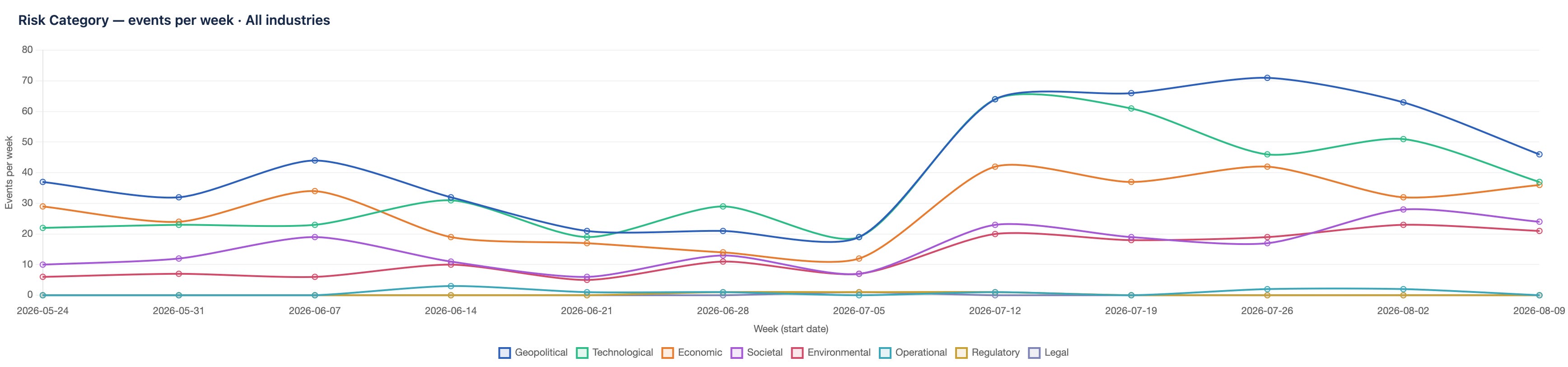
Using the data from our flagship AI powered threat intelligence tool*, we can see trends of events per threat category over time. This fortnight, the biggest increase in risks concerns (1) Geopolitical; 110 stories, (2) Technological; 90 stories, (3) Economic; 68 stories, (4) Societal; 52 stories, (5) Environmental; 44 stories.
Quick snippet stories
Middle East Workforce Mobility Under Strain
Regional disruption is forcing employers to rethink how people move across Middle East borders. The risk is straightforward: visa processing, assignment continuity, and evacuation logistics all fail simultaneously under geopolitical stress. Map immigration dependencies per assignee now, hold contingency permits in secondary jurisdictions, and rehearse relocation protocols before conditions deteriorate further.
Main link to resourceGoogle Earth Rollback Undermines Digital Evidence
Google Earth’s reversal of AI-enhanced imagery has exposed how fragile digital evidence has become. The risk sits with anyone relying on satellite imagery for insurance claims, environmental monitoring, or legal proceedings. Verify imagery provenance independently, retain original unenhanced source files, and require chain-of-custody documentation before submitting geospatial material as evidence.
Main link to resourceUK Jobs Market Enters Sharp Downturn
Britain’s labour market is reportedly suffering its worst slump since the financial crisis, with policy changes blamed for accelerating hiring freezes. The risk is concentrated in consumer-facing sectors and firms carrying high fixed employment costs. Stress-test workforce plans against demand contraction, review redundancy exposure early, and secure credit facilities before conditions tighten further.
Main link to resourceRhine Lows Prove Climate Risk Persists Record low Rhine water levels are again constraining European barge freight, echoing the drought and El Niño pressures we continue to monitor. Climate risk remains immediate despite attention shifting to AI and geopolitics. Pre-qualify rail and road alternatives for inland waterway routes, and build seasonal inventory buffers ahead of low-water periods.
Main link to resourceAI Reshapes Insurance Economics And Specialisation
Artificial intelligence is restructuring insurance underwriting, pricing, and claims specialisation. The risk is model concentration: insurers converging on similar AI-driven risk assessments could misprice systemic exposures simultaneously. Maintain independent human underwriting review for large or novel risks, audit model inputs regularly, and diversify carriers across differing assessment methodologies.
Main link to resource
More stories we’re following
Here are more threat updates we’re monitoring across the month listed for your convenience.
China launches cybersecurity review of Palo Alto Networks amid US-China tech war
Link ↗Apple’s Private Relay privacy service leaks users’ real IP addresses via WebKit browser flaws
Link ↗Thailand rice exports projected to fall 15% in 2026 amid Middle East conflict and El Niño
Link ↗Middle East LNG buyers hedge geopolitical risk by diversifying to Canadian supply
Link ↗American Red Cross declares second national blood supply crisis amid donor shortage
Link ↗Pacific island economies face mounting overlapping crises with depleted reserves
Link ↗Google rolls back Earth AI feature within 24 hours amid deepfake satellite imagery concerns
Link ↗Puerto Rico water crisis costs businesses $20M daily as drought triggers mandatory rationing
Link ↗Heatwave stuns British potato crops as European supplies also wither
Link ↗Yemen’s oil export collapse triggers state implosion, mass humanitarian crisis amid political paralysis
Link ↗UK services sector hits 22-month jobs slump matching 2008 financial crisis
Link ↗UK food leaders cite geopolitics, climate as top supply chain risks
Link ↗Record Rhine drought strains European supply chains, raising climate-driven transport risks
Link ↗Telstra data center equipment failure triggers five-hour nationwide outage
Link ↗Bangladesh measles crisis kills 844, infects 130,000 in four months
Link ↗Lotte Card faces 4.5-month suspension over repeat data breach affecting 2.97M customers
Link ↗Apple’s supplier shift forces Varta battery maker into insolvency restructuring
Link ↗Construction sector faces rising risk from geopolitics, supply chains, climate
Link ↗BCG finds AI alone fails supply chain planning; process maturity and data discipline required
Link ↗Kumamoto earthquake forces chipmaker shutdowns, ripples through global supply chain
Link ↗UAE warehouse demand surges despite Hormuz shipping crisis as businesses pivot supply chains
Link ↗
Want to discuss how these risks might effect your business?
Book 30 minutes with us, free ↗
Need support?
At Fixinc, we are passionate about helping people get through disasters. That’s why our team of Advisors bring you this resource free of charge. If you need help understanding these threats and building a plan against them, the same Advisors are here to help over a 30-minute online call. Once complete, if you like what was provided, you can choose to provide a donation or subscribe to Unbreakable Ventures to support this channel.


