




This week, Unbreakable Ventures welcomes Umaima Farhan as our newest Resilience Advisor and a regular contributor to this publication. Umaima is based on the ground in Dubai and has been reporting directly to the Fixinc advisory team since the conflict began. What follows is drawn from that correspondence.
The Gap
On 2 March 2026, the UAE President Sheikh Mohamed bin Zayed Al Nahyan walked through Dubai Mall at 9pm. He was accompanied by Sheikh Hamdan bin Mohammed, Crown Prince of Dubai, Deputy Prime Minister, and Minister of Defence. They greeted shoppers. They posed for photos. They sat down for coffee after breaking their Ramadan fast. The Dubai Media Office posted the footage with a caption that translates roughly to:
Do not worry, for the UAE is safe and secure, and its leadership is among its people and close to its nation.
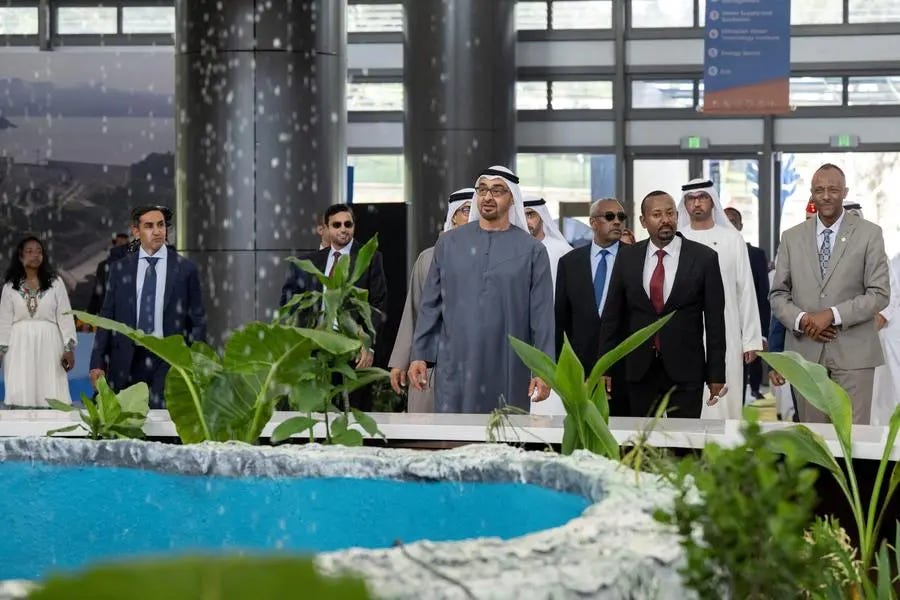
This happened on the same day the UAE Ministry of Defence confirmed it had intercepted 161 ballistic missiles, 645 drones, and 8 cruise missiles launched by Iran.
If you were scrolling your newsfeed outside the Middle East that day, you almost certainly did not see the Dubai Mall footage. You saw the missiles. You saw the fires near the Burj Khalifa and the Fairmont on Palm Jumeirah. You saw headlines declaring Dubai’s safe-haven image “shattered.” That framing was not entirely wrong. But it was incomplete. And incomplete framing during a crisis is where bad decisions are made.
What the Feed Shows vs. What the Ground Shows
Umaima’s sister lives in New York. She has been panicking. Her newsfeed is full of narratives framing this as a religious war, or a purely pre-emptive strike, without the context that escalation occurred while diplomatic negotiations with Iran were still ongoing in Geneva. US media coverage has also emphasised Dubai as unsafe and suggested foreign professionals are fleeing.
Umaima’s actual experience is different. Not safe in the abstract. Not without anxiety. But structured, managed, and continuing.
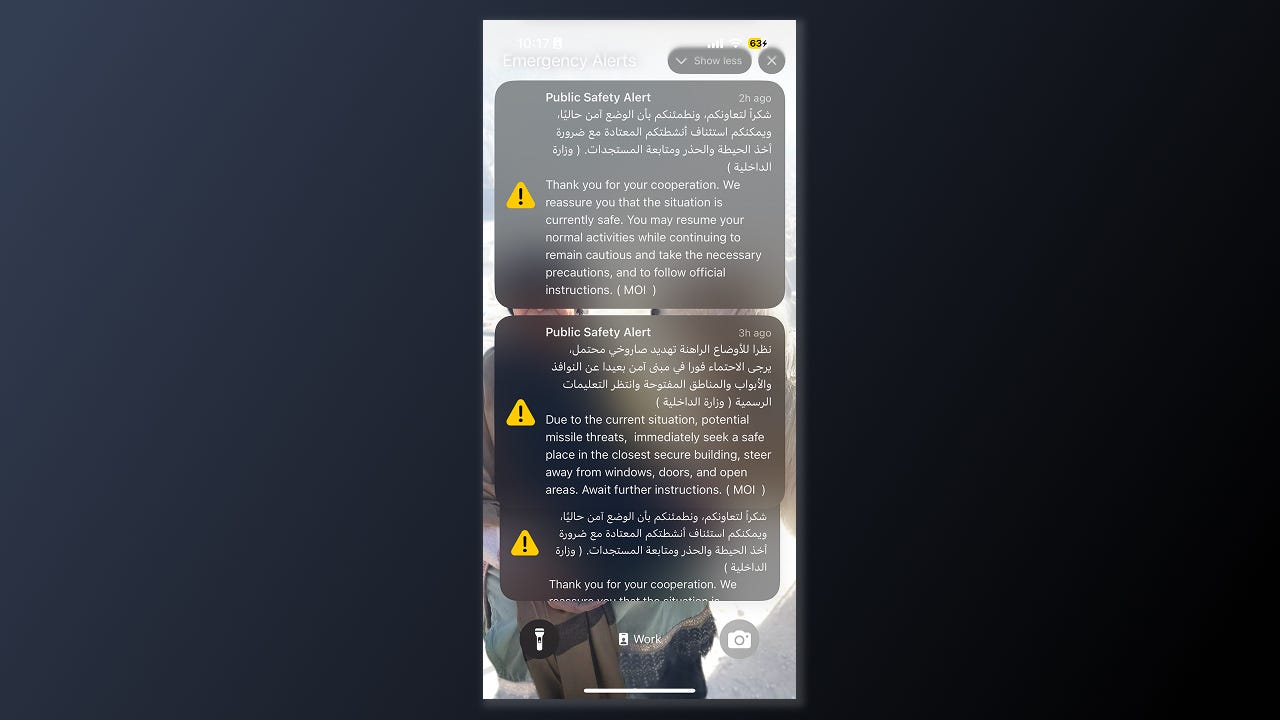
Residents in her building receive instructions through a WhatsApp group chat run by a long-term resident. The UAE's government alert system sends two types of text message: one directing residents to seek evacuation, and a follow-up confirming the situation has passed. At the building level, the response varies. In Umaima's building, the fire alarm sounds if evacuation is required. Otherwise, the instruction is to continue with daily life.
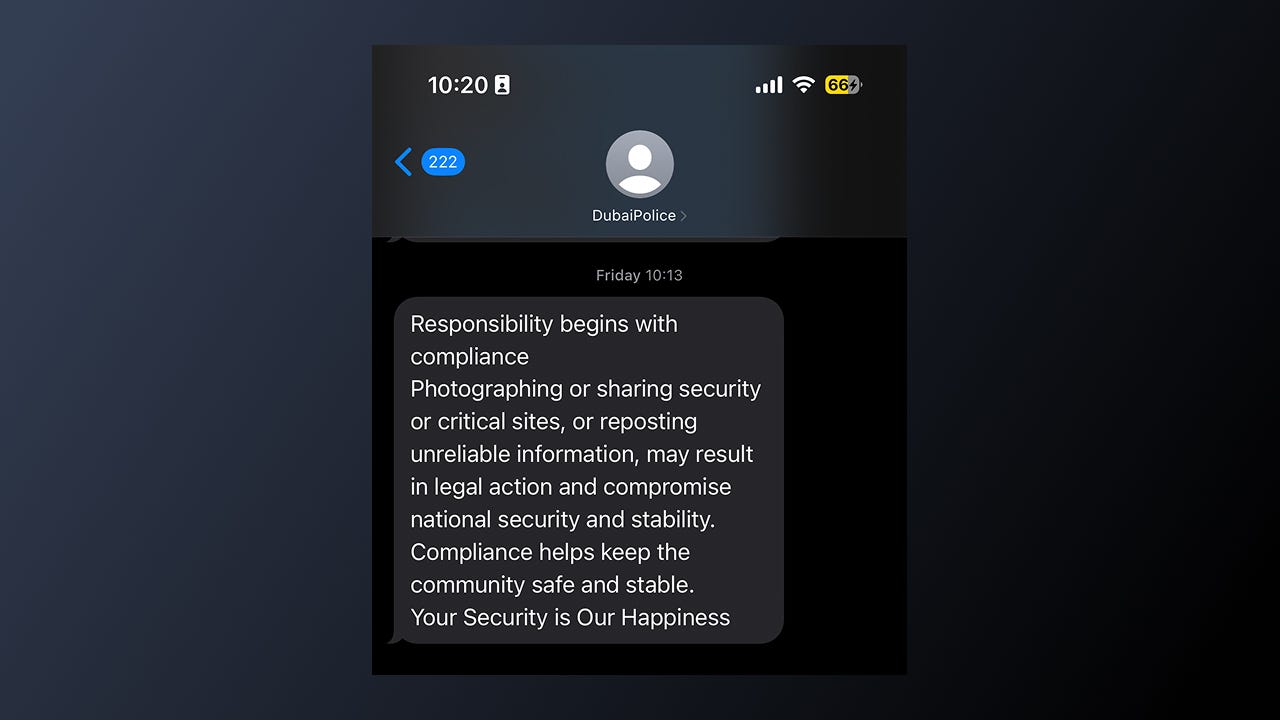
The sounds are real. Umaima describes interceptions as a fast-moving object across the sky, a quick flash or burst of light, followed seconds later by a loud boom. Near her area by the World Trade Centre, she hears something once or twice a day. Some days, nothing at all. The Dubai Police sent a message warning that photographing, sharing, or reposting critical sites or unverified information can result in legal action.
A drone struck the parking lot adjacent to the US Consulate in Dubai on 3 March. Secretary of State Marco Rubio confirmed no personnel were injured. (TIME) Umaima’s helper was near the scene and told her the fire was quickly handled. Emergency services arrived fast, told the crowd to move back, and that was it. Most people continued with their day. In Dubai, the rules are strict, especially for expats. People do not exaggerate or create chaos.
Two days after the first strikes, Holi was celebrated in the streets of Dubai. People threw colours, danced, and marked the festival as they do every year. Not at the same scale. A massive event weeks earlier had drawn thousands, with an India-Pakistan cricket match as a centrepiece. The Holi celebrations during the conflict were smaller, quieter, mostly within friend groups and communities. But they happened. Ramadan continued. Iftaar events went ahead. A badminton group chat organised art therapy and sound therapy sessions led by a psychologist in the group. A charity drive collected donations for children injured in Iran.
None of this made the international newsfeed. The leadership walking through a shopping mall during an active missile defence operation tells you something about the actual threat level that no amount of headline writing can convey.
The Business Continuity Picture
The media narrative around Dubai’s economy focuses on cancellations, capital flight, and chaos. There is truth in that. Hotel bookings dropped over 50%. Emirates initially suspended operations before resuming at around 60% capacity by 6 March. Tourism is taking a significant hit.
But the operational picture on the ground is more measured than the headlines suggest.
Hedge funds and multinational firms in the Dubai International Financial Centre moved into contingency mode early. Many have since resumed fuller on-site operations while keeping flexible work options available. (Bloomberg Law) DP World confirmed all Jebel Ali terminals were operating normally with enhanced safety measures. (Khaleej Times) AD Ports reported the same. ADNOC confirmed onshore operations continued using emergency protocols and alternative export routes. (Gulf News)
The UAE government warned 449 firms over price hikes since the conflict began, actively managing market stability as part of its continuity posture. (Khaleej Times)
Schools and universities moved to distance learning under a Ministry of Education directive, with a return date communicated through official channels, Khaleej Times, Gulf News, and Lovin Dubai on Instagram. The messaging was consistent. One directive, one date, one set of instructions. For context, after the Christchurch terrorist attack in 2019, Fixinc (publication owners of Unbreakable Ventures) observed schools across the city sending contradictory messages because the Ministry of Education provided no guidance. This caused significant unrest particularly from parents. Dubai’s coordinated approach here is notable.
The Dubai Metro kept running. Roads stayed open. No curfews were imposed. Transport infrastructure continued to function. The government communicated early that there was enough stock in the country for at least four to six months of food and basic necessities. Residents were asked not to panic-buy, and most followed that guidance.
Umaima’s father works in electronics and appliance trading. His company is navigating uncertainty around airspace closures affecting deliveries. Their US offices are supporting operations while the Dubai team manages the situation day by day. That is business continuity in practice. Not a press release. Not a framework diagram. A team adjusting in real time.
The Water Question
One of the sharper risks in any Gulf conflict is water. The UAE is heavily dependent on desalination. A targeted strike on key infrastructure would create a serious humanitarian problem.
But the picture is more resilient than some reporting suggests. The UAE has approximately 70 desalination plants across the country. A similar incident in Bahrain, where a drone strike damaged part of a desalination facility, did not disrupt the national water supply. The Financial Times reported that the UAE maintains around 45 days of strategic water reserves as a contingency buffer. (Financial Times)
The risk is real. Acknowledging the redundancy does not dismiss it. But reacting to a headline about two weeks of water supply without understanding the distributed nature of the infrastructure is exactly the kind of gap this article is about.
The Information Architecture That Actually Works
One of the most interesting findings from Umaima’s reporting is where people are actually getting their information. It is not government websites. It is not traditional news. It is Instagram and WhatsApp.
The two most widely followed sources in Dubai are @LovinDubai and @modgovae (the UAE Ministry of Defence). Updates are fast, trusted, and accessible. Emergency contact numbers were shared across community Instagram pages and reposted widely within the first hours of the conflict.
For the older generation, WhatsApp is the primary channel. Umaima’s grandparents in Kuwait rely on WhatsApp group chats where members flag information as “verified” or “unverified” themselves. During COVID, this same pattern played out. WhatsApp gives quick, digestible updates. News broadcasts feel overwhelming.
Meanwhile, the US Embassy’s crisis notification system required an American phone number to register. Umaima could only sign up because her sister lives in the US. The crisis intake form returned an error the first time she submitted it. These are not minor UX issues. For an American citizen in a conflict zone, the inability to register for emergency notifications is a critical failure of crisis communication.
The contrast is worth sitting with. The UAE’s Ministry of Defence is posting bilingual alerts on Instagram that reach millions within minutes. The US Embassy’s notification system does not work without a domestic phone number.
What This Means For Your Business
Brad Law, Co-Founder and Head of Advisory at Fixinc, puts it simply:
The way you structure your information management during a crisis could be the difference between a measured response and a costly misstep. It is never too late to ask within your organisation how developed your situational awareness strategy actually is.
In practice, this comes down to three disciplines: collect, assess, act.
Start with collection. Identify credible sources for obtaining information. First-hand insight is always the most valuable, as this article demonstrates through Umaima’s reporting from the ground. Maintain multiple channels for sourcing that information, because some will go offline or fail during a crisis.
The US Embassy’s notification system is a case in point. Be prepared to distinguish between facts and assumptions from the outset, and establish how each will be handled. Log everything. If it is not recorded, it did not happen.
Then assess. Build mechanisms for evaluating incoming information against potential business impacts across people, operations, financial exposure, and regulatory obligations. Maintain a regular cadence for reassessment. What starts as an assumption on day one may become a verified fact by day three. Your response should evolve with the picture, not stay anchored to the first report you received.
Then act. Assessment without action is just commentary. Ensure that the information you have collected and evaluated generates clear outputs: situation reports, stakeholder briefings, media statements, or the activation of business continuity plans and IT disaster recovery. These are the tangible products of good situational awareness.
And then repeat. Collect, assess, act. Refine the picture as new information emerges. The situation in Dubai changed materially between the first weekend and the following Wednesday. Organisations that locked into a single response posture on day one and never revisited it were making decisions on stale intelligence by midweek.
If your organisation has operations in the Gulf, employees based in the region, or supply chain dependencies that route through the Middle East, the lesson here is straightforward. Your crisis response should not be driven by your newsfeed.
Establish direct, on-the-ground contacts. Umaima’s reporting has been more accurate, more timely, and more nuanced than anything published by international media in the first week. If you do not have someone in-country feeding you verified information, you are making decisions based on incomplete data.
Verify before you react. The gap between what international media reports and what is happening on the ground is significant. A business that activated a full evacuation based on early headlines may have overreacted. A business that assumed everything was fine based on the same headlines may have underreacted. Neither position was informed.
Watch the local channels. Instagram accounts like @LovinDubai and @modgovae are faster and more accurate than most wire services for on-the-ground updates in Dubai. WhatsApp group chats within buildings and communities are providing real-time, localised instructions. If your risk team is not monitoring these, they are missing the most relevant signal.
Do not confuse media volume with threat severity. The fact that Holi celebrations continued in the streets, that the President and Minister of Defence walked through a shopping mall during active missile interceptions, and that the Metro kept running, does not mean the situation is not serious. It means the response is proportionate. Your response should be too.
The Bigger Point
Every crisis produces a gap between what the media reports and what is actually happening. That gap is where overreaction lives. It is where panic buys, unnecessary evacuations, and poorly timed decisions are born.
Umaima put it well:
The general message people seem to be getting here in Dubai is that you should be cautious but not panic.
That is the message for your business too. Be cautious. Monitor. Plan. Activate when the facts warrant it. But do not let a newsfeed written for clicks dictate your crisis response. The people who started this conflict are doing a worse job communicating with their own citizens than the local government managing the fallout. That should tell you something about where to place your trust.
The view from the ground is always clearer than the view from the feed.
Umaima Farhan is a Resilience Advisor at Fixinc and a regular contributor to Unbreakable Ventures. She is based in Dubai.
If you need help building a crisis response plan or understanding how the current conflict may affect your operations, the same Advisors who collate these insights are available for a 30-minute consultation. Book time here.