





Hello 👋 get a brew on because these are the top emerging risks between July 15th, and July 29th, 2026…
Review our report’s terminology here ↗
Our main risk this fortnight is…
1. Geopolitical: Global Chokepoints Squeeze Trade Flows
Recent disruption in the Strait of Hormuz has highlighted a broader dynamic: pressure in the global economy is not evenly distributed, concentrating in narrow chokepoints where a single actor or natural force can restrict trade.
Businesses need to understand exposure and build innovation for when chokepoints, such as the Strait of Hormuz, rare earth elements, or semiconductor markets, are pinched.
When auto demand soared in 2021 to 2022, automakers were left short of semiconductors, delaying or reducing production and resulting in about 13 million fewer light-duty vehicles produced from 2021 to 2023.
Importing economies rely on three or fewer nations for their main share of global trade. The US imports primarily from China, Mexico, Canada, and Europe, with China concentrated on commodities, autos, and pharmaceuticals.
In an era defined by renewed great power competition, geopolitical distance again matters, increasing pressure on the sprawling, globally distributed supply chains that arose after the Cold War.
Sources
Chokepoints: How to respond when the global economy gets squeezed | McKinsey | July 2026
How global disruption is reshaping manufacturing supply chains | McKinsey | January 2026
McKinsey Global Supply Chain Leader Survey 2024 | McKinsey | October 2024
You should be concerned if…
Manufacturers reliant on semiconductors or critical materials: Concentrated supply of chips and rare earths means a single chokepoint event can halt production for months. The 2021 to 2023 auto shortfall shows how quickly narrow dependencies cascade into lost output and revenue.
Energy-dependent economies and shippers routing through the Gulf: The Strait of Hormuz carries a substantial share of global oil and LNG. Any restriction affects insurers, refiners, and downstream industries far beyond the immediate region, driving price volatility and supply uncertainty.
Firms concentrated in few sourcing countries: Importers relying on three or fewer nations face acute exposure. Sudden tariffs, export controls, or conflict at a single origin point leave little short-term substitution capacity to keep goods moving.
Companies with limited supply-chain visibility: Organisations that cannot map dependencies beyond tier-one suppliers will discover chokepoint exposure only during a crisis. Blind spots in deeper tiers convert a manageable event into a prolonged operational shock.
These items are generic assumptions. We recommend considering your own unique risk landscape against your critical dependencies. If you don’t know what they are, get in touch.
Preventative actions
Map chokepoint exposure across all tiers
Identify where products, materials, and logistics routes pass through concentrated dependencies with limited substitutes. Extend mapping beyond tier-one suppliers to reveal where a single event could restrict flow across your entire network.
Diversify sourcing and build strategic buffers
Reduce reliance on any single country or route by qualifying alternative suppliers and holding targeted buffer stock for critical inputs. Dual-sourcing and regionalisation improve structural resilience against sudden restrictions at concentrated nodes.
Adopt scenario planning and digital modelling
Use scenario planning and digital modelling to build proactive resilience rather than reacting to disruptions. Stress-test multiple chokepoint scenarios, from shipping-lane closures to export controls, so responses are pre-planned rather than improvised under pressure.
Track geopolitical and industrial-policy signals
Monitor tariffs, export controls, and investment restrictions that reshape production footprints. Early awareness of policy shifts lets firms reposition sourcing and inventory before a chokepoint tightens rather than scrambling afterwards.
2. Technological: Third-Party Risk Threatens Supply Chains
Companies have spent years strengthening their supply chains against disruption, but Swiss Re says many have overlooked one of the biggest risks by focusing only on their own operations, instead of partners’ weaknesses too.
The study found that 43% of Fortune 500 Europe companies report assessing physical risk to their own facilities, but only 7% publicly disclose extending such assessments to supplier facilities, and fewer than 2% disclose assessing the wider infrastructure they rely on.
Supply chains today are more interconnected than ever. A disruption at a supplier, a power provider, or a transport hub can have consequences well beyond the location where the event occurs.
Modern supply chains extend far beyond the vendors an organisation directly manages. Each third-party relationship is underpinned by its own network of fourth and nth parties, creating exposure that most organisations can neither see nor control.
Gartner research reveals that third-party breaches cost roughly 40% more to remediate than those that originate within an organisation’s own systems, due to added complexity spanning multiple entities and jurisdictions.
Sources
Study: Supply chain disruption may come from beyond a company’s own walls | DC Velocity | July 2026
Third-Party Risk Statistics | Recorded Future | November 2025
You should be concerned if…
Organisations with hundreds or thousands of suppliers: Monitoring vast vendor networks is so complex that third-party risk is often lived with rather than removed. Yet a single unprepared supplier can create a major, invisible vulnerability in your resilience.
Firms assessing only their own facilities: With just 7% extending risk assessments to suppliers and fewer than 2% to wider infrastructure, most companies carry hidden exposure. These gaps stay unidentified until a disruption forces a costly, reactive scramble.
Businesses dependent on fourth and nth parties: Exposure created by subcontractors, cloud services, and technology providers is largely unseen and uncontrolled. A failure deep in the chain can ripple back with consequences the direct buyer never anticipated.
Security and continuity teams: Third-party breaches cost around 40% more to remediate than internal incidents because they span multiple entities, jurisdictions, and data environments. Unmanaged vendor risk multiplies both financial and regulatory exposure.
Preventative actions
Return to the basics of resilience
Ask every third party a simple question: do you have a plan, and when did you last validate it? If a supplier cannot provide that in writing, verified within the last twelve months, you have identified a major vulnerability immediately.
Map suppliers on a risk maturity spectrum
Build a map of third and even fourth parties you would consider unacceptable on the risk maturity spectrum. This prioritises attention on the weakest links, letting you act promptly rather than investigating thousands of vendors indefinitely.
Extend assessments beyond your own walls
Push risk assessments outward to supplier facilities and the wider infrastructure you rely on. Understanding dependencies beyond your operations determines whether you recover quickly or face prolonged disruption when an upstream event strikes.
Make resilience continuous, not periodic
Shift from episodic risk reviews to continuous preparedness, integrating ecosystem partners into stress testing. Treat resilience as a core business discipline with clear ownership rather than a periodic IT or procurement initiative.
Risk Flow Graph
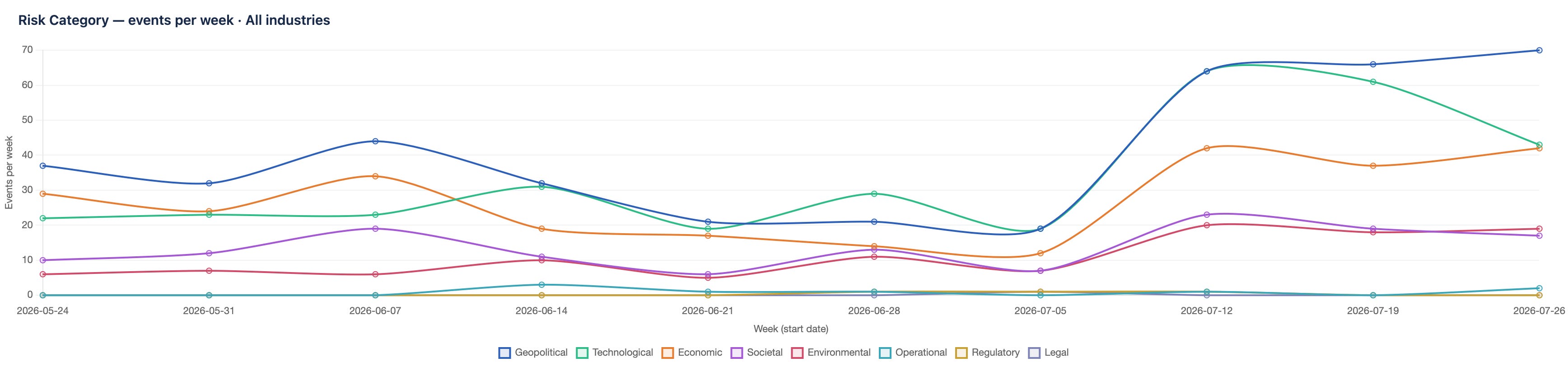
Using the data from our flagship AI powered threat intelligence tool*, we can monitor trends in risks per threat category over time. This fortnight, the biggest increase in risks concerns (1) Geopolitical; 70 stories, (2) Technological; 43 stories, (3) Economic; 42 stories, (4) Societal; 17 stories, (5) Environmental; 19 stories.
Quick snippet stories
Utilities Pledge to Shield Consumers from AI Power Costs
More than 200 entities have joined Trump’s voluntary Ratepayer Protection Pledge to ensure US ratepayers are not saddled with costs from the AI data centre buildout. The risk is that the pledge is entirely voluntary and has little control over pricing set by state regulators, with prices already rising sharply in some states. Consumers should scrutinise local tariff filings.
Main link to resourceEuropean Retailers Face Worst Distress Since 2008
The Weil European Distress Index shows distress rising across all markets, with retail-sector distress hitting its highest level since the global financial crisis, driven by weaker growth, deteriorating confidence, and energy market turmoil. The risk stems from squeezed profits and shaky consumer spending. Firms should protect liquidity and stress-test balance sheets against further cost shocks.
Main link to resourceMalaysia Confronts Escalating Data Leak Crisis
Malaysia faces mounting data breach exposure as rapid digitalisation outpaces protection. The country’s push to become a regional digital hub has made it more visible to threat actors, with programmes accelerating adoption but exposing gaps across fragmented, multi-vendor environments hard to monitor. The core risk is supply-chain compromise. Organisations should tighten vendor oversight and breach detection.
Main link to resourceH5N1 Detection Exposes Insurance Coverage Gaps
Broker Howden argues H5N1 clade 2.3.4.4b presents a different risk profile because it has become established in wild bird populations across continents, creating repeated spillover opportunities rather than isolated events. The risk is downstream exposure across food manufacturing, retail logistics, and hospitality, sectors whose insurers may not have priced avian influenza into business interruption books. Review policy wordings now.
Main link to resourceHidden Fragilities Threaten Auto Supply Chains
Automotive supply chains carry deep structural vulnerabilities beneath the surface. The 2021 to 2022 chip crunch showed how a single concentrated dependency can halt production, leaving automakers exposed when demand and supply diverge. The risk lies in unseen sub-tier reliance. Manufacturers should map deeper tiers and diversify critical component sourcing.
Main link to resource
More stories we’re following
Here are more threat updates we’re monitoring across the month listed for your convenience.
TSMC thwarts first alleged chip-tech theft to China under national security law
Link ↗Yemen descends toward civil war as Houthis blockade Saudi ports, threaten shipping
Link ↗Employee engagement plummets 24 points as workers withdraw psychologically from work
Link ↗70% of firms lack reliable multi-tier supplier visibility despite tech investments
Link ↗UK retailers accelerate festive shipments as Red Sea disruptions spike freight costs 61 percent
Link ↗US pharma tariffs threaten global supply chains, Malaysia faces indirect cost and availability pressures
Link ↗Australian automotive SMEs delay maintenance, tech investment amid cost crisis
Link ↗New York enacts first statewide data center construction ban amid grid strain fears
Link ↗EU forces Google to open Android to rival AI assistants, sparking security showdown
Link ↗AI-generated books flood Amazon marketplace amid lax platform oversight
Link ↗Geopolitical tensions threaten to derail global growth as India loses economic momentum
Link ↗South Africa expands oil reserves to 60-day threshold amid Middle East tensions
Link ↗UK launches national emergency preparedness campaign amid cyber, weather, and geopolitical threats
Link ↗Automotive sector faces permanent semiconductor reallocation to AI, restructuring supply chain logistics
Link ↗Asia Pacific shippers expect growth amid normalized supply chain disruption
Link ↗UK businesses normalize elevated financial risk amid pandemic late payments supply chain disruption
Link ↗Meta removes Instagram AI opt-out feature, forcing mandatory algorithmic personalization
Link ↗OpenAI denies stealing Apple intellectual property amid allegations
Link ↗Nichirei cyberattack disrupts frozen food logistics, cascades to KFC Japan operations
Link ↗
Want to discuss how these risks might effect your business?
Book 30 minutes with us, free ↗
Need support?
At Fixinc, we are passionate about helping people get through disasters. That’s why our team of Advisors bring you this resource free of charge. If you need help understanding these threats and building a plan against them, the same Advisors are here to help over a 30-minute online call. Once complete, if you like what was provided, you can choose to provide a donation or subscribe to Unbreakable Ventures to support this channel.


