





Hello 👋 get a brew on because these are the top emerging risks between October 22nd, and November 4th, 2026…
Review our report’s terminology here ↗
Our main risk this fortnight is…
1. Technological: Executives Unprepared for Cyber Recovery
Databarracks wargames show business leaders handle the communications and governance side of a cyber attack well, but struggle with the technical work of containing the breach and recovering safely from verified clean backups.
Very few leaders in the exercises mentioned restoring from verified clean backups. This gap matters because restoring from infected or corrupted backups can let attackers back into the network and extend downtime well beyond the first incident.
Some teams move crisis coordination to other messaging apps, but Databarracks warns that this does not make communications secure. Clean channels, trusted contact details, identity checks and decision logs need to be agreed and rehearsed in advance.
Databarracks’ own Data Health Check suggests confidence is outpacing capability, with many organisations describing themselves as very confident in ransomware response despite never fully testing their ability to recover from cyber attacks.
AI-generated phishing, deepfake voices and faster intrusions give executives less time to decide. Cyber policies often include incident response support, but it works best when the client’s own crisis team is ready to act on it.
Sources
You should be concerned if…
Board members and executive leadership teams: Executives who are good at stakeholder messaging may still lack the technical knowledge to authorise containment, isolate systems or validate recovery points. AI-accelerated attacks leave little time to learn those decisions during an incident.
Organisations relying on cyber insurance for response: Insurer-provided incident response teams can only move as fast as the client’s internal decision-makers. Firms without a rehearsed crisis team risk slower recovery, larger losses and tougher scrutiny at renewal.
UK consumer-facing brands and regulated sectors: High-profile attacks on well-known UK brands have shown how quickly a breach becomes a public crisis. Strong communications cannot make up for systems that stay offline because recovery was never properly tested.
Hybrid and remote leadership teams: Databarracks warns that managing a crisis over screens reduces situational awareness and splits communication across too many tools. Distributed executive teams face a greater risk of confusion, duplicated decisions and missed signs of staff fatigue.
IT and security teams: Technical teams are often left to handle containment and recovery alone when executives lack a shared playbook. Without clear board ownership and pre-agreed authority, critical decisions such as shutting down systems stall.
These items are generic assumptions. We recommend considering your own unique risk landscape against your critical dependencies. If you don’t know what they are, get in touch.
Preventative actions
Run technical-track executive wargames
Run tabletop exercises at least twice a year in which executives must decide when to isolate networks, which backups to trust and what to restore first. Include AI-generated phishing and deepfake impersonation scenarios.
Upskill leaders on cyber recovery fundamentals
Train board members on immutable backups, recovery point objectives, forensic preservation and clean-room restoration. Leaders who understand these concepts can authorise recovery decisions faster and challenge assumptions from IT and vendors.
Establish out-of-band crisis communications
Set up a communications platform that runs outside corporate identity systems, with verified contact lists, call-back identity checks and a code-word protocol. Test it quarterly so teams can resist AI voice cloning and impersonation.
Prove clean backup recovery
Schedule full restoration tests from immutable or offline backups into an isolated environment, and scan for dormant malware before go-live. Record actual restore times against targets and report gaps to the board each quarter.
Integrate insurer resources into the plan
Map your cyber policy’s incident response panel, hotline and approval steps directly into the crisis playbook. Invite the insurer’s breach coach into an exercise so handoffs and decision rights are tested before a live incident.
2. Economic: Aircraft Parts Shortage Threatens Air Cargo
Longer repair lead times, supplier instability and persistent disruption are forcing airlines and aftermarket providers to rethink procurement, inventory and logistics strategies, according to industry leaders speaking at MRO Europe in Amsterdam.
DHL’s aviation procurement lead said supply chain disruption is now a permanent feature of the market rather than a temporary pandemic hangover. Some OEMs have also added surcharges that hide the true underlying cost of parts.
Geopolitics is adding to the strain. European MROs depend heavily on US engine and component OEMs, and some report customer engines sitting for months awaiting parts. This has prompted calls for European supply sources and more in-house repair.
Global shipping is already constrained, which makes air cargo a critical fallback for time-sensitive goods. Aircraft grounded while waiting for components reduce available capacity, which is likely to push freight rates and maintenance costs higher.
Operators are moving from lean just-in-time models to hybrid approaches with just-in-case buffers. They are also demanding firmer delivery commitments, earlier disruption warnings and visibility beyond direct suppliers into deeper supply tiers.
Sources
MRO Supply Chain Disruption Drives Shift in Procurement Strategies | Aviation Week | October 2026
Aftermarket Logistics Managers Adapt to Supply Chain Paradigm Shifts | Aviation Week | October 2026
Business Considerations MROs Face Given Geopolitical Tensions | Aviation Week | October 2026
You should be concerned if…
Shippers of time-critical and high-value goods: With sea routes already strained, air freight is often the fallback. Fewer available aircraft could tighten capacity and raise rates at the moment sea disruption pushes more volume into the air.
Airlines and cargo operators: Every aircraft waiting on a component means lost revenue and stranded capacity. Opaque OEM surcharges and longer repair turnarounds make maintenance budgets harder to forecast and erode already thin operating margins.
European MRO providers: Heavy reliance on US engine and component OEMs leaves European providers exposed to trade and political pressure. Customers’ engines sitting idle for months damages relationships and pushes work toward better-supplied competitors.
Australia, New Zealand and Pacific economies: Long distances from major OEM and repair hubs mean longer shipping times for parts. These economies also depend more on air freight for imports, exports and perishable trade, so any capacity squeeze hits harder.
Procurement and finance teams: Surcharges that hide underlying part costs make it harder to benchmark prices or challenge increases. Teams budgeting freight and maintenance on historical rates risk significant overruns over the coming year.
Preventative actions
Build risk-based spares buffers
Identify the rotables and engine parts whose failure grounds an aircraft, and hold just-in-case stock or pooled spares for them. Keep lean just-in-time ordering only for low-criticality, readily available consumables.
Map sub-tier suppliers
Require key component suppliers to disclose their own critical sub-suppliers and sourcing countries. Flag single-source parts tied to one OEM or jurisdiction, and qualify alternative repair shops or PMA parts where approved.
Secure contractual delivery commitments
Negotiate firm turnaround times, early-warning clauses and transparent surcharge breakdowns in repair and parts contracts. Link service credits to missed commitments so suppliers carry part of the cost of delays.
Lock in and diversify air freight capacity
Secure block space or capacity agreements with multiple carriers and forwarders before peak demand. Build higher freight costs into pricing and identify which shipments could move to slower modes without breaching customer commitments.
Integrate procurement, engineering and logistics
Create a joint planning cell linking procurement, engineering, maintenance planning and logistics. Use predictive maintenance data to order long-lead parts earlier, and review exposure to component delays at monthly fleet meetings.
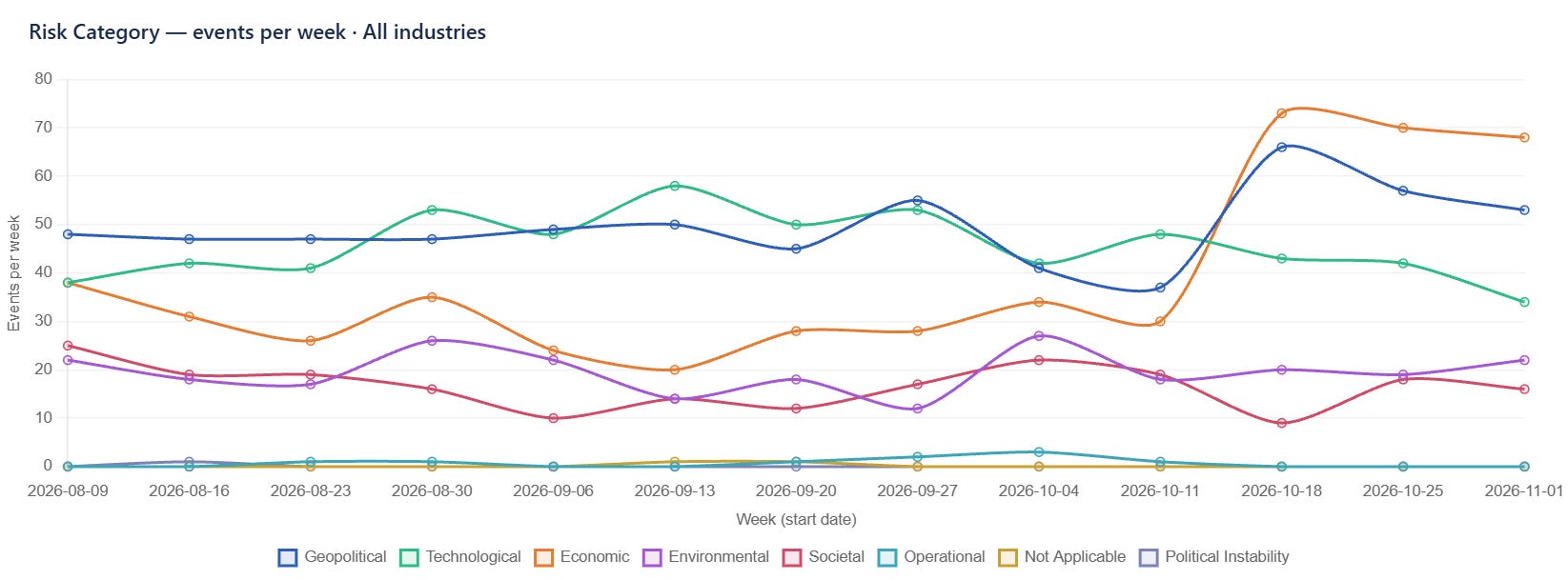
Risk Flow Graph
Using the data from our flagship AI powered threat intelligence tool*, we can see trends of events per threat category over time. This fortnight, the biggest increase in risks concerns (1) Economic; 138 stories, (2) Geopolitical; 110 stories, (3) Technological; 77 stories, (4) Environmental; 41 stories, (5) Societal; 34 stories.
Quick snippet stories
Downtime Becomes Routine for UK Manufacturers
Aviva research finds unplanned downtime is routine for smaller UK manufacturers. Supply chain disruption is the most cited cause, ahead of cyber incidents, equipment failure and staff shortages. As Middle East conflict and low river levels strain trade routes, map single points of failure, qualify backup suppliers and cross-train staff to flex production.
Main link to resource ↗Europe Faces a Costly Winter for Fuel
Iran’s Abbas Araghchi has linked rising fuel prices to geopolitical tensions as Europe’s gas market comes under strain. As winter approaches, heating demand will collide with constrained supply, threatening affordability for households and energy-intensive industry. Secure hedged energy contracts, audit peak consumption and prepare tested demand-reduction and backup power plans before temperatures fall.
Main link to resource ↗Ports Become Geopolitical Assets
Ports, corridors and logistics hubs are increasingly treated as tools of strategic competition, with ownership, financing and route control shaping who holds leverage over trade. For port operators, including in Australia, this raises exposure to foreign investment scrutiny, sanctions and shifting shipping patterns. Audit crane, software and operator dependencies, model rerouting scenarios and engage regulators.
Main link to resource ↗El Niño Drought Signals Hydro Power Risk
El Niño-driven drought is hitting Papua New Guinea, an early signal of what a strong El Niño could bring across the region this summer. New Zealand and parts of Australia rely heavily on hydroelectricity, and falling dam inflows tighten supply and lift prices. Install onsite solar and batteries, and hedge electricity contracts against price spikes.
Main link to resource ↗Cyber Cover Grows, Recovery Readiness Lags
Cyber cover is reaching more businesses, but a policy pays for losses rather than preventing them. Insurers increasingly price risk on controls a business can demonstrate, so organisations with weak recovery capability face higher premiums, exclusions or slower claims. Document multi-factor authentication, tested backups and incident response exercises, and present that evidence at renewal.
Main link to resource ↗
More stories we’re following
Here are more threat updates we’re monitoring across the month listed for your convenience.
Amadeus travel booking breach exposes data at Qantas, Cathay Pacific and other airlines Link ↗
Accenture contractor’s Claude agent allegedly leaked Pentagon credentials and network map Link ↗
Saudi Arabia to store crude in Singapore caverns as Hormuz disruption reshapes Asian supply Link ↗
Geopolitical conflict reaches boardrooms and disrupts operations across global organisations Link ↗
Anthropic warns catastrophic AI incidents may be uninsurable as Canadian insurers face OSFI scrutiny Link ↗
Want to discuss how these risks might effect your business?
Book 30 minutes with us, free ↗
Need support?
At Fixinc, we are passionate about helping people get through disasters. That’s why our team of Advisors bring you this resource free of charge. If you need help understanding these threats and building a plan against them, the same Advisors are here to help over a 30-minute online call. Once complete, if you like what was provided, you can choose to provide a donation or subscribe to Unbreakable Ventures to support this channel.


