



Hello 👋 get a brew on because these are the top emerging risks between November 5th, and 18th, 2026…
Review our report’s terminology here ↗
Our main risk this fortnight is…
1. Economic: Power Equipment Waits Outrun Insurance Cover
One transformer failure at NSW’s Waratah Super Battery in October 2025 cut capacity from 850 MW to 350 MW. A year later full output still had not returned, with losses estimated at A$50 to 80M.
An FM survey found 61% say business interruption terms do not match real recovery times. Lead times for transformers, turbines and generators run up to five years, while 90% of BI policies cover 12 months.
The queue is lengthening. AEMO forecasts roughly 28% growth in electricity consumption over the next decade, and data centre demand is set to roughly triple by FY30, competing for the same scarce equipment.
Recovery often stalls before work starts. Tokio Marine GX finds service agreements take 6 to 8 weeks to agree, with insurers and contractors often meeting for the first time after the loss.
After a regional event, Sedgwick’s research warns, everyone competes for the same contractors. In New Zealand, insurers have increased solar deductibles, shifting more recovery cost onto asset owners already facing long equipment waits.
Sources
You should be concerned if…
Battery storage and renewable generators in the NEM: A single transformer failure can idle capacity for more than a year. If BI cover ends at 12 months, every lost month beyond that, and any contracted grid service shortfall, falls onto the balance sheet.
Data centre operators and large energy users: With data centre demand set to roughly triple by FY30, operators now compete with generators for the same transformers and generators. A failed on-site substation or backup power unit faces the same multi-year queue.
New Zealand solar operators: Higher solar deductibles mean more of every loss is retained before cover responds. Combined with long equipment lead times, operators may carry both a larger repair bill and extended downtime with limited insurance support.
Brokers and risk managers: Brokers already see a wider BI gap than their clients. Willis notes power rates have fallen for two years, creating a window to renegotiate limits, deductibles and indemnity periods against real lead times.
Project financiers and investors: Lenders model revenue on assumed uptime. A multi-year outage covered for only 12 months pressures covenants, especially on new and hybrid technologies that 65% of power companies call underinsured or inconsistently treated.
These items are generic assumptions. We recommend considering your own unique risk landscape against your critical dependencies. If you don’t know what they are, get in touch.
Preventative actions
Build your BIA on real equipment lead times
Set recovery time objectives using supplier-confirmed lead times for transformers, turbines and generators, not policy limits. Where lead times reach three to five years, document the gap between realistic recovery and your BI indemnity period.
Pre-agree response plans with insurers and contractors
Remove the 6 to 8 week stall by signing master service agreements, nominating loss adjusters and agreeing response protocols with insurers and OEM contractors before any loss. Run a joint tabletop exercise annually.
Secure critical spares or join a shared pool
Identify single points of failure such as high-voltage transformers and hold strategic spares or join a shared spares pool with other operators. Confirm storage, maintenance and transport arrangements so a spare can be deployed quickly.
Pre-qualify repair partners for regional events
After a regional storm, every asset owner calls the same contractors. Pre-qualify at least two electrical and civil repair partners, confirm their surge capacity in writing, and agree priority response terms before the event.
Align procurement, contracts and insurance on one timeline
Map recovery timelines for each critical asset, then align procurement, supplier contracts and insurance to match. As Willis advises, revisit limits, deductibles and BI assumptions now, while softer power rates give buyers more leverage
2. Economic: Digital Bank Collapse Topples Paraguay’s President
Paraguay’s central bank seized fast-growing digital lender ueno, freezing deposits for about 3 million people, including pensioners. Within three days, President Santiago Peña had resigned and faced impeachment, a political collapse triggered by one lender.
Long queues formed outside branches as customers tried to reach their money. Protests were met with tear gas and water cannon, and a government promise to return funds within five days failed to calm anyone.
On 3 November, authorities called it “a particular case of one entity, not of the national financial system.” That day the central bank chief resigned at the president’s request. The president soon followed.
Governance flags were present: ueno was under scrutiny for lending to owner-linked companies. The central bank chief had run it until 2023, and it held about $850M in public and pension funds.
One fast-growing digital bank was paying pensions for a large share of the population. When the government’s late measures failed to match what people were experiencing, trust collapsed faster than officials could respond
Sources
You should be concerned if…
Organisations relying on a single bank or payments provider: If payroll, supplier payments or cash reserves sit with one institution, a regulatory seizure can freeze operations overnight. Ueno’s depositors lost access to funds before any credible recovery timeline existed.
Pension funds and public bodies: About $850M in public and pension funds sat with one lender. Treasury teams and fund managers holding concentrated deposits in fast-growing institutions risk losing access to funds and face intense political scrutiny when those institutions fail.
Fintechs and digital banks in emerging markets: Rapid growth built on convenience can outpace governance. Related-party lending concerns and close ties between lender and regulator, both present at ueno, can trigger the same scrutiny and depositor panic in other markets.
Businesses with operations or staff in Paraguay: Frozen deposits for about 3 million people mean employees, customers and suppliers may be unable to pay or be paid. Protests met with tear gas add risk to staff movement and site security.
Organisations serving pensioners and vulnerable customers: Pensioners were among those frozen out. Organisations serving older or low-income customers should expect hardship requests, missed payments and heightened reputational sensitivity when a widely used payment channel suddenly fails.
Preventative actions
Define escalation triggers before you need them
Set measurable triggers, such as customer queues, social media spikes or payment failures above a threshold, that automatically convene the crisis team. Pre-authorise decision rights so leaders act within hours, not days.
Communicate the impact people actually feel
Draft statements that answer the questions affected people are asking: when can I access my money, how do I pay bills, who do I call. Never issue reassurances that contradict what stakeholders can see.
Diversify banking and payment providers
Spread operating cash, payroll and supplier payments across at least two unconnected institutions. Maintain a tested secondary payroll route that can run within one pay cycle if a primary bank is frozen.
Run counterparty governance checks
Review banking and fintech partners for related-party lending, leadership links to regulators and unusually rapid deposit growth. Treat these as early warning indicators, with a defined threshold that triggers a reduction in exposure.
Exercise early decision-making
Run a tabletop exercise where your main bank is seized on a Friday. Test how quickly leaders decide on staff pay advances, supplier deferrals and public statements, then close the delays you find.
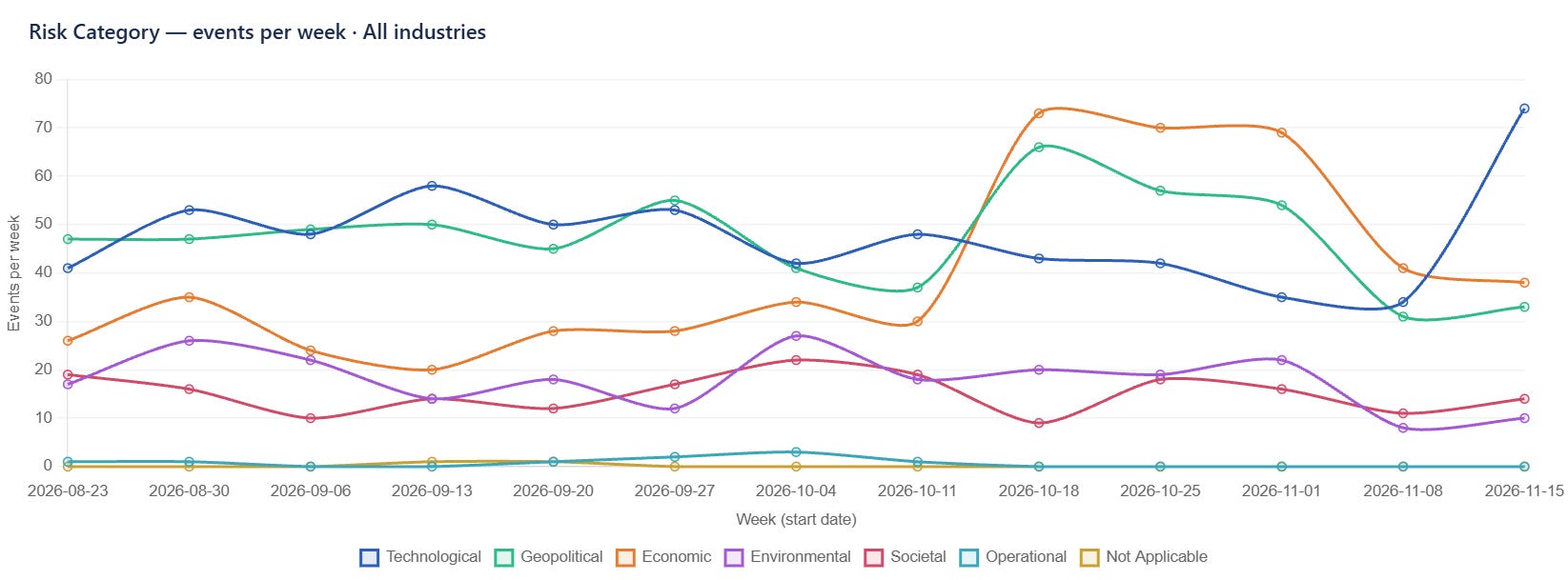
Risk Flow Graph
Using the data from our flagship AI powered threat intelligence tool*, we can see trends of events per threat category over time. This fortnight, the biggest increase in risks concerns (1) Technological; 97 stories, (2) Economic; 76 stories, (3) Geopolitical; 58 stories, (4) Societal; 19 stories, (5) Environmental; 18 stories.
Quick snippet stories
Indonesia Puts Its Own Grid Before Singapore’s Gas
Indonesia cut gas exports to Singapore to meet its own power needs. The grid coped (under 2% of demand), but some businesses had deliveries reduced. A reliable supplier can be overruled across the border, and Jakarta is weighing contract renewal. Map energy dependencies and pre-agree alternatives. Contracts and insurance will not keep operations running.
Main link to resource ↗Workday Backup Test Takes Down HR Systems
Workday went down on a Friday after a problem surfaced during backup systems testing, leaving some data inconsistent. Service returned at 11am the next day. Payroll, leave and HR tasks stalled for many of its 11,500-plus customer organisations. Give DR tests their own controls and rollback plans, and keep manual payroll and timesheet workarounds.
Main link to resource ↗First Strike Hits Taiwan’s Chip Industry at Micron
Taiwan’s chip industry’s first strike hit Micron’s Taoyuan plant, which makes over 60% of Micron’s DRAM. Union membership jumped from about 440 to over 13,000. TrendForce says a short strike mainly dents customer confidence in delivery reliability. A longer one could disrupt AI hardware supply. Model workforce disruption and secure backup staffing for critical roles.
Main link to resource ↗Claude Code Settings Files Leak Secrets to GitHub
Claude Code’s “Yes, and don’t ask again” option can save full commands, including passwords and API keys, to a settings file that sometimes lands on public GitHub. Apiiro found about 1,100 exposed secrets across 63 organisations, and popular scanners missed 215 of them. AI coding tools create hidden secret stores. Govern them and rehearse your response to credential leaks.
Main link to resource ↗Wheat Prices Rise on Logistics, Not Scarcity
RaboResearch says wheat prices are climbing because grain cannot move reliably, not because supply is short. For Australian growers, fertiliser lead times of several months, against 30 to 40 days for diesel, make fertiliser the bigger budget and continuity risk. El Niño also threatens eastern Australia’s 2027-28 crop. Plan input orders around lead times.
Main link to resource ↗
More stories we’re following
Here are more threat updates we’re monitoring across the month listed for your convenience.
Chinese military-linked universities obtain restricted Nvidia AI chips through domestic suppliers Link ↗
Railway breach exposes customer secrets, drives $740,000 in fraudulent AI charges Link ↗
Fireworks AI breach exposes customer billing data and datasets, spilling into Notion AI Link ↗
US export curbs fail to stop Nvidia’s advanced AI chips reaching China Link ↗
Spain general strike over housing shuts Madrid shops and disrupts metro networks Link ↗
Rare earth supply shocks could cut Japan, US and German GDP by up to 1.8% Link ↗
AI lowers barriers for cybercriminals as ransomware and supplier attacks drive claims Link ↗
Grocery cyberattacks expose cyber accumulation and coverage gaps for insurers Link ↗
Solar Hail Losses Outpace Recovery Capacity, Tokio Marine GX Warns Link ↗
US tariffs and trade probes loom over ASEAN as Trump visits Southeast Asia Link ↗
Europe faces fresh bomb hoaxes against flights and broadcasters causing diversions Link ↗
Sedgwick warns UK property repair capacity and underinsurance could falter under El Niño stress Link ↗
Want to discuss how these risks might effect your business?
Book 30 minutes with us, free ↗
Need support?
At Fixinc, we are passionate about helping people get through disasters. That’s why our team of Advisors bring you this resource free of charge. If you need help understanding these threats and building a plan against them, the same Advisors are here to help over a 30-minute online call. Once complete, if you like what was provided, you can choose to provide a donation or subscribe to Unbreakable Ventures to support this channel.


